
FOOD · LOCAL PRODUCERS · TRADITIONS · KATO MILIA, PIERIA
The Ritual of Tsipouro Distillation | A Greek Tradition in Kato Milia, Pieria
Discover Pieria Differently · Greek Heritage · Local Life
A night around a traditional copper still, where fire, family, food and friendship come together in one of Greece’s enduring rural traditions.
There are some experiences that are difficult to explain through photographs alone.
You need to be there. To feel the warmth of the fire, hear the sounds of the distillation process, smell the aromas filling the room and spend time with the people who keep the tradition alive.
On 14 November 2023, I visited a small family distillery in Kato Milia, Pieria, to experience the traditional production of Greek tsipouro.
What I found was more than a production process. It was a gathering of people, a family tradition and a way of life that brings together generations, friends and neighbours around a copper still.
The distillery belonged to the Pouliakis family, whose winemaking and distillation traditions are continued by winemaker and producer Giorgos Pouliakis.
As the evening unfolded, I began to understand why the distillation of tsipouro is sometimes described as a kind of ritual.
Not a religious ceremony, but a ritual of work, patience, hospitality and shared moments.
The Experience at a Glance
- Location: Kato Milia, Pieria, Greece.
- Producer: Giorgos Pouliakis.
- Family business: Oraia Gi Winery (Orea Gi).
- Experience: Traditional Greek tsipouro distillation.
- Equipment: Traditional copper still and wood-fired furnace.
- Production: Double-distilled tsipouro, with and without anise.
- Atmosphere: Family, friends, food, fire and Greek hospitality.
- Visit: By prior arrangement with the winery.
The Tradition Behind Greek Tsipouro
Tsipouro is a traditional Greek spirit made from grape pomace, the skins, seeds and other remains left after winemaking.
For generations, grape growers and winemakers have found a way to make use of what remains after the wine has been produced. Through fermentation and distillation, these grape residues become another expression of the vineyard and its harvest.
The production of tsipouro is closely connected with the agricultural calendar. First comes the cultivation of the vines, then the harvest, the winemaking process and, finally, the distillation.
It is a continuation of the work that begins in the vineyard months earlier.
Across Greece, traditional distillation has also developed a strong social character. The distillery becomes a meeting place where people gather, help with the work, share food and spend time together.
The equipment and methods may vary from one place to another, but the connection between the producer, the land and the people remains an important part of the experience.
A Family Tradition in Kato Milia
At Oraia Gi Winery, in Kato Milia, the production of tsipouro is part of the wider work of the vineyard and winery.
Giorgos Pouliakis explains that distillation is the final stage of the annual cultivation cycle.
Throughout the year, the family cultivates its vineyards, produces grapes, makes wine and eventually uses the grape pomace for the production of tsipouro.
He describes this as a traditional process followed by earlier generations of his family, passed down from their grandparents.
The family produces double-distilled tsipouro, both with anise and without anise, offering two different expressions of the traditional Greek spirit.
During my visit, I also had the opportunity to meet his father, Mr. Pouliakis, who was actively involved in the distillation process.
Watching father and son working around the same equipment offered a simple but meaningful glimpse into the continuity of family knowledge.
The Copper Still and the Work Behind the Distillation
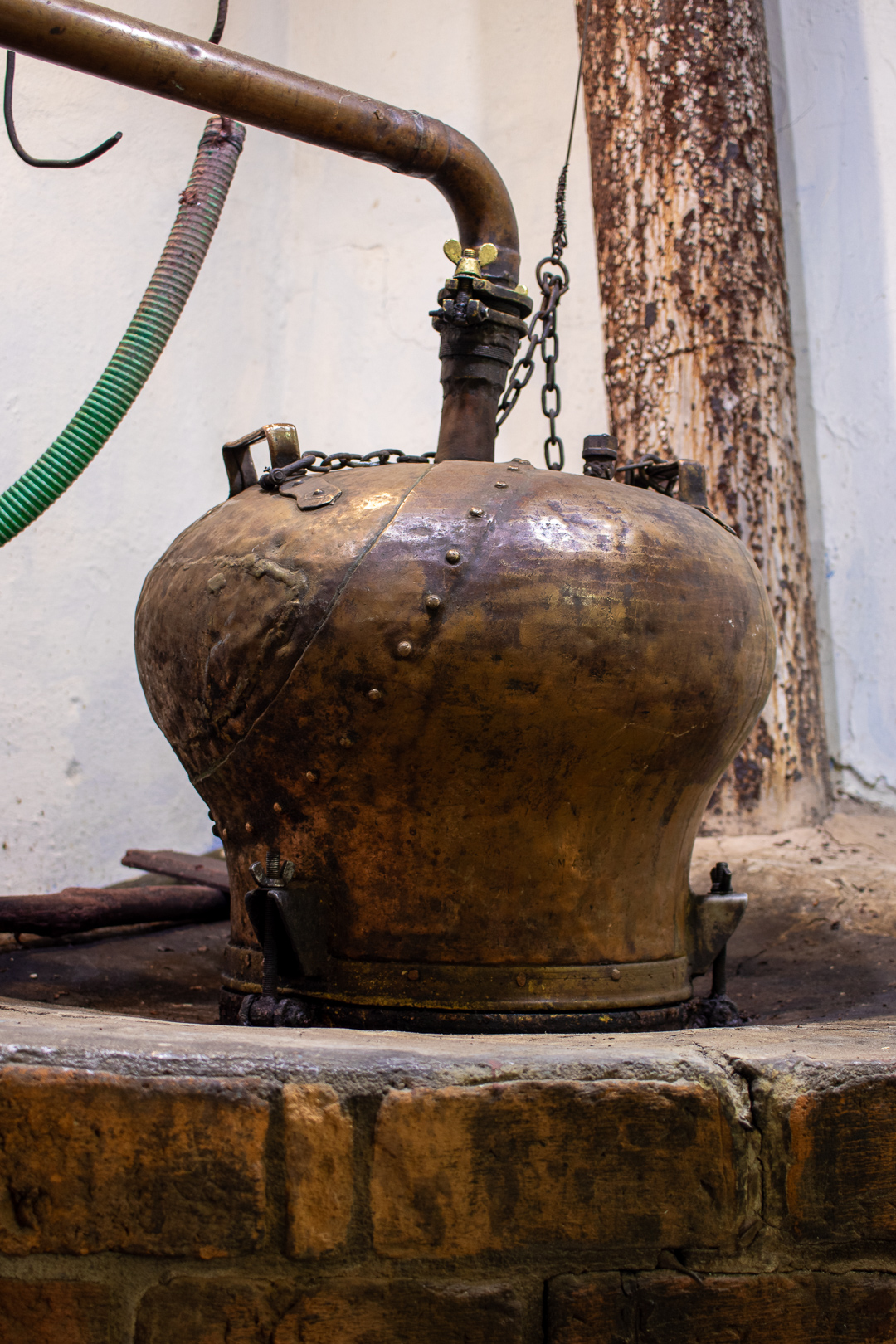
The copper still is at the centre of the distillery.
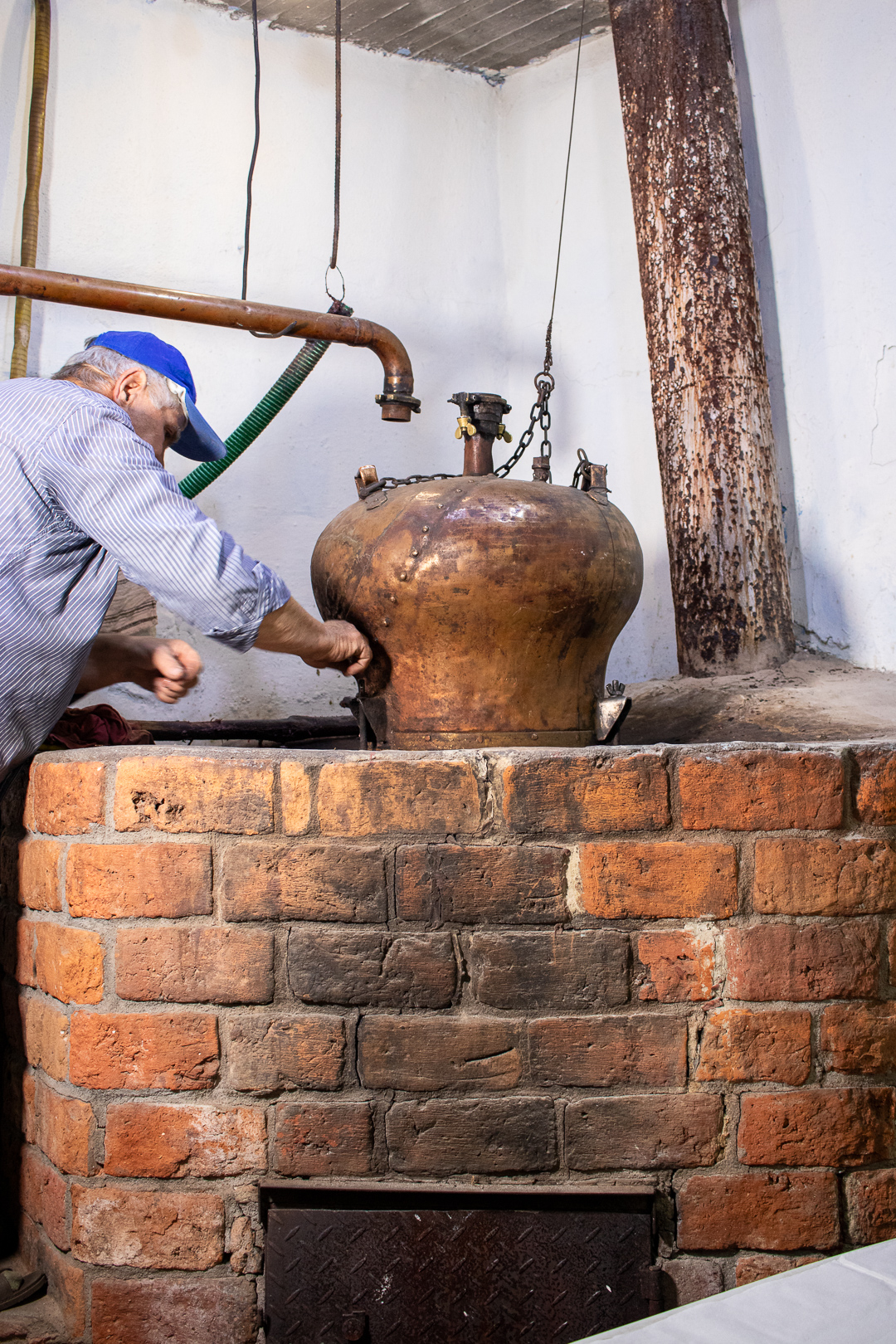
It sits above a brick-built furnace, where wood is used to provide the heat needed for the distillation process.
The atmosphere is very different from that of a modern industrial production facility. The equipment, the fire and the movements of the people working around it give the space a distinctive character.
During the process, the fermented grape pomace is heated inside the still. Alcohol vapours travel through the distillation system, are cooled and eventually collected as liquid distillate.
The producer carefully monitors the process and the quality of the spirit being collected.
At one point, I asked Mr. Pouliakis what was happening.
“We are changing the batch,” he explained.
The still was opened, a wooden shovel was used to move the grape pomace out, and the hot liquid remaining inside was released.
Once the still was emptied, the copper lid was secured again and the distillation pipe was connected in preparation for the next batch.
It was a practical sequence of actions, carried out with the familiarity that comes from experience.
Fire, Time and the Atmosphere of the Distillery
The distillation process requires time and attention.
The fire needs to be maintained, the equipment monitored and each stage completed before the next batch can begin.
Giorgos was constantly involved in the work, adding firewood to the furnace and preparing the next batch.
The smell inside the distillery was intense. It filled the small space and became part of the entire experience.
There was something almost mysterious about the atmosphere.
The warm light, the copper equipment, the fire and the aromas created an environment that felt quite separate from the everyday world outside.
The work can continue through the night and, during these long hours, the distillery becomes a temporary living space for the producers. Food, rest and sleep take place there between the different stages of the process.
It is not simply a matter of switching on a machine and waiting for the finished product.
It requires presence, experience and patience.
When the Distillery Becomes a Meeting Place
One of the things that impressed me most was the social side of the experience.
The distillery was a small space, but it was full of life.
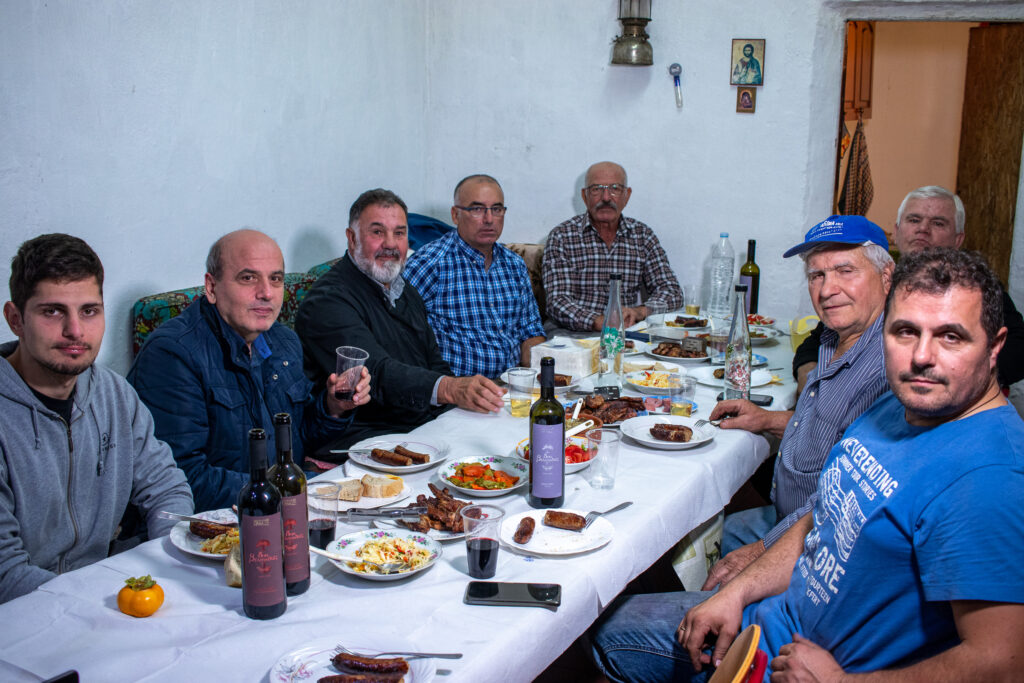
Giorgos’s father was there, as well as the village priest and friends who had come together to celebrate the producer and wish him well.
Visitors and friends also contributed to the table, bringing sausages, meat for grilling and different kinds of meze to share.
Everyone brought something. Everyone had a place.
The distillation was the reason for gathering, but the evening was also about friendship, conversation and supporting one another.
This is an important part of the traditional distillery experience in rural Greece. The gathering is not separate from the work. It grows around it.
While the fire continues to burn and the distillation moves forward, people eat, talk, laugh and spend time together.
For the producers, it is a demanding part of the agricultural year. For their friends and visitors, it becomes an opportunity to take part in something that belongs to local life.
The same spirit of cooperation and hospitality has helped keep these traditions alive through generations, even as the equipment and production methods have evolved.
From the Copper Still to the First Glass
After following the different stages of the process, it was time to see the finished distillate.
The clear spirit was collected and Giorgos used a special measuring instrument, an alcoholmeter, to check its alcoholic strength.
It was another reminder that traditional production is not simply about following an old recipe. Experience and careful measurement are also essential parts of producing a consistent spirit.
The distillation process had brought us from the vineyard to the copper still, and finally to the clear spirit in the glass.
But the evening was not over.
Good Wishes, Local Wine and Greek Hospitality
At the end of my visit, I was invited to join the group around the table.
The welcome was warm and spontaneous.
Glasses were raised, people exchanged wishes and we toasted together.
Two expressions were heard repeatedly:
Greek Wishes from the Distillery
Kali Sodeia — Καλή Σοδειά — A good harvest.
Kala Krasia — Καλά Κρασιά — Good wines.
Simple wishes that carry the hopes of another agricultural season.
It was a fitting ending to an evening that had brought together the people, the work and the products of the vineyard.
The tsipouro was part of the celebration, but so were the local wine, the food and, above all, the people around the table.
This is the side of Greek hospitality that I find especially meaningful: it is not organised for visitors or performed for a camera. It happens naturally, because people want to share what they have.
The Experience: A Night Around the Tsipouro Still
The short film captures the atmosphere of the evening at the Pouliakis family distillery.
From the traditional copper still and the preparation of the next batch to the fire, the finished spirit and the gathering around the table, it offers a glimpse into a living Greek tradition.
A night of tradition, friendship and Greek hospitality in Kato Milia, Pieria.
Meet the Producer: How Greek Tsipouro Is Made
In the second video, Giorgos Pouliakis explains the connection between vineyard cultivation, winemaking and distillation.
He also talks about the family tradition, the production of double-distilled tsipouro with and without anise, and how visitors can arrange to experience the process themselves.
Experience Traditional Tsipouro Distillation in Pieria
One of the most interesting things I learned during my visit was that the experience is not limited to the family and their friends.
Giorgos explained that visitors can also arrange to come to the winery and follow the distillation process.
Depending on the season and prior arrangements, a visit can include:
- Watching the traditional tsipouro distillation process.
- Learning about the copper still and the different stages of production.
- Discovering the family’s vineyards and winemaking activities.
- Tasting wines and locally produced spirits.
- Experiencing the agricultural traditions of the area.
According to Giorgos, the distillation season at Oraia Gi Winery generally runs from 15 October to 15 December.
With prior telephone communication, visitors can also arrange to experience grape harvesting and winemaking during the relevant periods of the agricultural calendar.
Plan Your Visit
- Winery: Oraia Gi Winery (Ωραία Γη).
- Producer: Giorgos Pouliakis.
- Location: Kato Milia, Pieria, Greece.
- Distillation season: Generally 15 October – 15 December.
- Visits: By prior telephone arrangement.
- Experiences: Distillation, winemaking, wine and spirit tasting, depending on availability.
Contact the winery in advance to discuss available dates and the possibility of joining the different stages of production.
More Than a Drink: A Tradition of People and Place
The experience in Kato Milia made me think about the relationship between local products and the people who produce them.
A bottle of tsipouro may seem like a simple product when we see it on a shop shelf or on a restaurant table.
But behind it there is a vineyard, an agricultural season, knowledge passed between generations, hours of work and a gathering of people.
The distillery becomes a place where these different elements meet.
It is where the agricultural work of the year reaches another stage, where family knowledge is put into practice and where friends come together to support the producer.
The atmosphere may feel like a ritual, but its meaning is also very human.
People work together. They share food. They exchange wishes for a good harvest and good wines. And they keep a tradition alive by continuing to practise it.
This is one of the reasons I enjoy discovering local producers and their stories across Pieria.
A destination is not defined only by its mountains, beaches and famous attractions. It is also shaped by the people who live there, the products they create and the traditions that remain part of everyday life.
Discover More Local Stories from Pieria
The story of tsipouro is closely connected with the wider agricultural and gastronomic identity of the region.
If you enjoy discovering the people, products and traditions behind local food, you may also enjoy these stories:
-
Wine, Harvest & Local Life in Pieria | A Night Among the Vineyards
— Another evening at Oraia Gi Winery, celebrating the grape harvest among the vineyards of Kato Milia. -
Olive Harvest in Pieria, Greece | A First-Hand Experience with Forelia
— Follow the olive harvest and discover the people and work behind local olive oil. -
The Sounds of Olympus | A Summer Afternoon in Skotina, Pieria
— Local ingredients, cooking, regional wine and the natural sounds of a summer afternoon.
The Pieria I Know
For me, the most memorable part of this visit was not simply seeing how tsipouro is made.
It was being welcomed into a small family distillery, meeting the people behind the process and sharing a few hours of their lives.
The copper still, the fire and the aromas created the atmosphere. The food and the conversations made it feel like home.
And when the glasses were raised and everyone wished for a good harvest and good wines, the whole experience came together.
Sometimes, to understand a place, you simply need to sit at its table.
That is another side of Pieria worth discovering.
Discover Pieria Differently
Explore the people, places, local products and experiences that make Pieria and Mount Olympus special.
From family-run wineries and traditional producers to mountain villages and authentic local gatherings, there are many stories waiting to be discovered.
