
What Does Pieria Taste Like? | Gastronomic Festival of the Mountain & the Forest
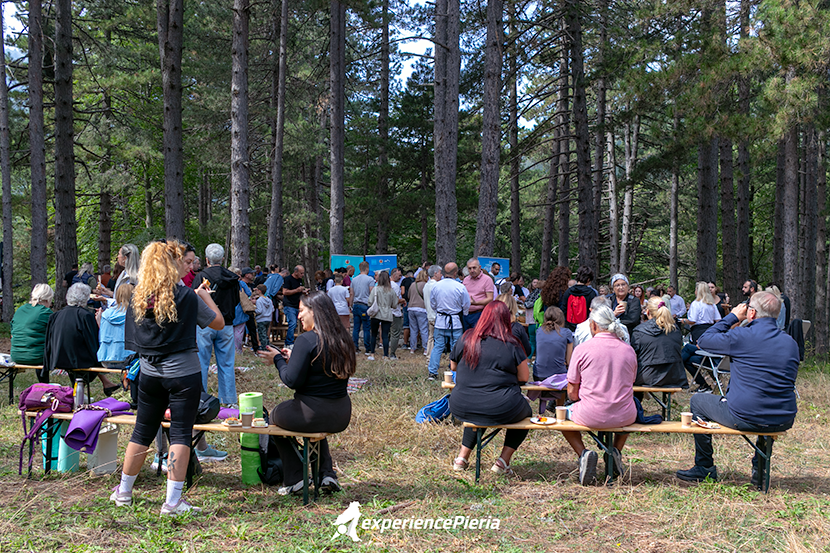
What Does Pieria Taste Like? A Morning at the Gastronomic Festival of the Mountain & the Forest in Elatochori
A personal journey through food, forest, people and the flavours of Pieria.
What does Pieria taste like?
Maybe it tastes like warm bread, local cheese, mushrooms, chestnuts and honey.
Maybe like Greek coffee sweetened with flower honey.
Or perhaps like strawberry juice with lemon and mint, drunk under the trees of the Pierian mountains.
But after spending a morning at the Gastronomic Festival of the Mountain & the Forest in Elatochori, I think the answer is slightly different:
you don’t really taste a place until you experience it.
And on this particular morning, the experience began before the first bite.
At a Glance
- Location: Elatochori, Pieria, Greece
- Setting: Mountain forest and village landscapes of the Pieria Mountains
- Experience: Local food, Pierian Breakfast, live cooking, Pilates, traditional music and nature
- Best for: Food lovers, families, photographers, nature travellers and visitors interested in local culture
- Travel style: Gastronomy combined with nature, local products, people and slow travel
A Morning in the Forest
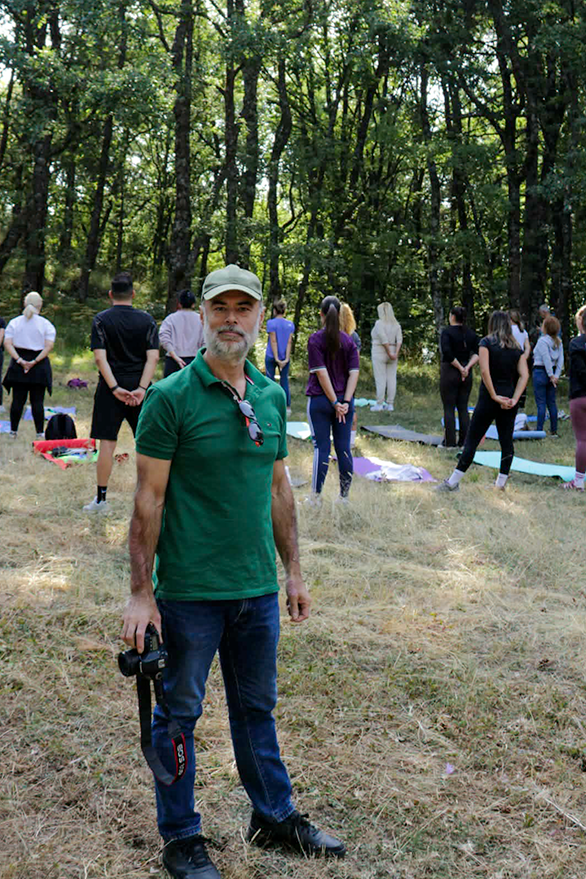
I left Litochoro early and met a young friend at Plaka Litochoro at around 8:00 in the morning.
He is a chef and an amateur photographer, so the plan was simple:
go to Elatochori, see what was happening and experience the festival through our cameras,
but also without them.
We passed through Ritini on the way.
I had planned to visit the
Holy Monastery of Agios Georgios Ritini
,
but quickly realised that it deserved more time than a rushed visit.
So I left it for another day.
We continued towards Elatochori and arrived early at the forest location known as Μπάρα.
The sun was beginning to rise through the trees.
The clearing was already bright enough for a Pilates session,
chefs were preparing breakfast and birds were doing what birds do best:
reminding everyone that we were not in a conference room.
It was warm enough for short sleeves.
The forest was awake.
And then a happy dog came towards my camera.
It sniffed the microphone, came closer to my face and started wagging its tail
with the kind of enthusiasm that no tourism campaign could ever plan.
That little moment became the opening of my video.
I wanted the video to feel less like an official festival report and more like
the eyes and ears of someone actually spending the morning there.
Watch the experience:
What Does Pieria Taste Like? | Gastronomic Festival of the Mountain & the Forest
Arriving Before the Crowd
Arriving early gave us time to simply look around.
I sat on a wooden bench and watched the preparations.
There was something satisfying about seeing a festival before it becomes a festival:
chefs finishing dishes, volunteers moving things around, people arriving slowly,
cameras appearing and the forest continuing its own morning routine.
It was not yet crowded.
There was no rush.
And that gave me the opportunity to observe the details that are usually lost
once an event becomes busy.
Before the Food, There Was Breath
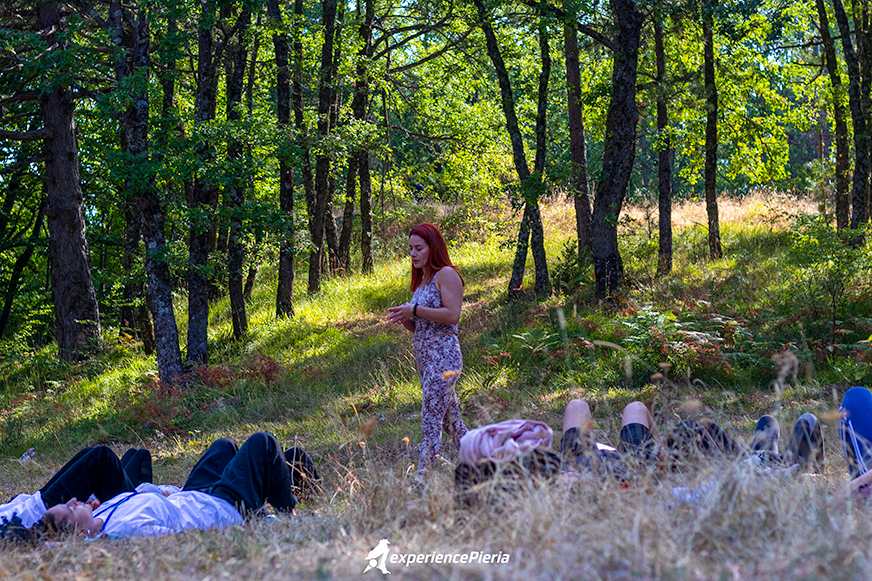
The morning began with Pilates in the forest with Katerina Venieri.
Her voice, together with the sounds of the forest, immediately changed the rhythm of the morning.
One phrase that stayed with me was:
“Allow yourself to feel good.”
There was something appropriate about starting a gastronomic experience this way.
Before talking about food, we were reminded to breathe.
To slow down.
To pay attention to the body and to the environment around us.
It reminded me of something I had written previously about another way of experiencing
the forests of Pieria:
Forest Bathing in Olympus: When Nature Becomes Therapy
.
Different experience, different intention, but a similar idea:
nature is not simply the background.
It becomes part of the experience itself.
Then Came Breakfast — The Forest’s Way
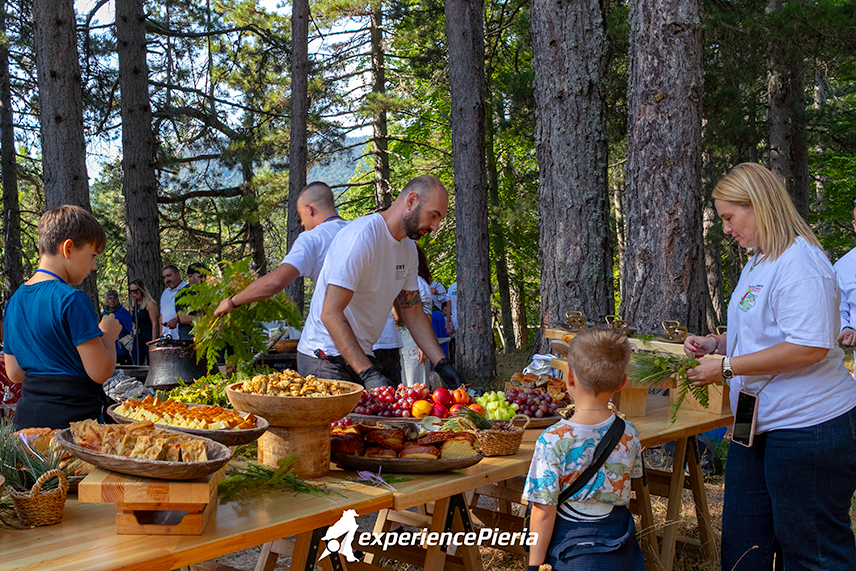
After Pilates came the Pierian Breakfast,
presented in cooperation with the Pieria Hoteliers Association.
When we first arrived, there was no queue.
The chefs were still finishing some of the dishes,
explaining what visitors would taste and preparing the buffet.
When everything was ready, people were invited to come and take what they wanted.
Everyone moved at their own pace.
Later it became much busier, but people continued to find their place,
sit down and enjoy their food.
That relaxed rhythm suited the forest.
What Does Pieria Taste Like?
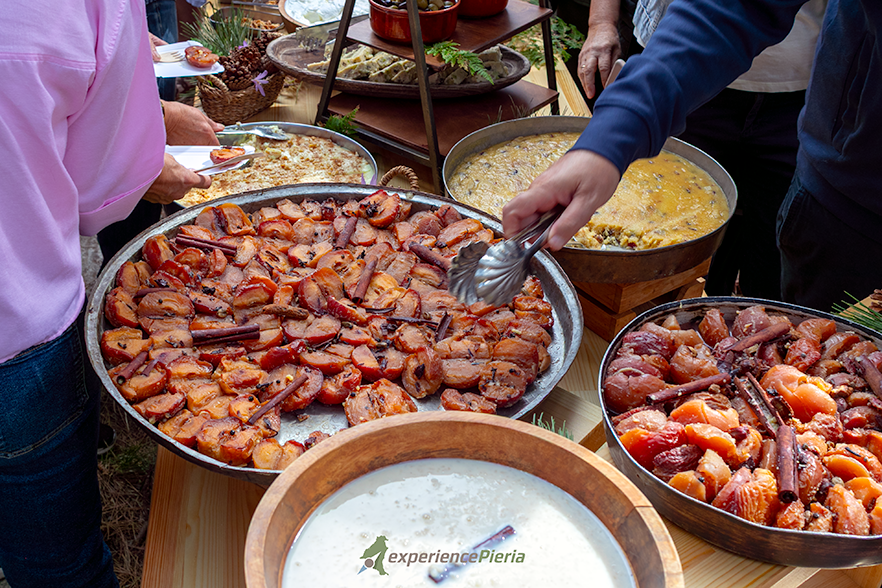
The breakfast brought together many flavours associated with Pieria:
local cheeses, yogurt, honey, jams, olives, bread, pastries, fruit and traditional preparations.
One small detail stayed with me.
I normally drink Greek coffee with half a teaspoon of brown sugar.
Here I tried it with flower honey.
It was different from my usual morning coffee — and surprisingly good.
There was also a pink strawberry drink made with strawberries from
Svoronos, together with lemon juice and mint.
Svoronos has a long connection with strawberry production.
Today, when people think of Pieria’s agricultural identity,
Olympus kiwifruit is probably one of the first things that comes to mind.
But the strawberry still has its own place in the story of the region.
Traditional Food, Local Ingredients and a Little Creativity
What I found interesting was not simply the number of dishes.
It was the way traditional ingredients and recipes were being treated as material for creativity.
Chefs from Culinary Professionals Greece,
under the coordination of Chef Dimitris Dermisis,
worked with local products and familiar Greek flavours,
presenting them in ways that felt contemporary without losing their connection to tradition.
There were local cheeses, smoked pork, mushrooms, chestnuts, herbs,
trachanas, vegetables, honey, nuts and traditional sweets.
Some dishes were immediately recognisable.
Others made you look twice.
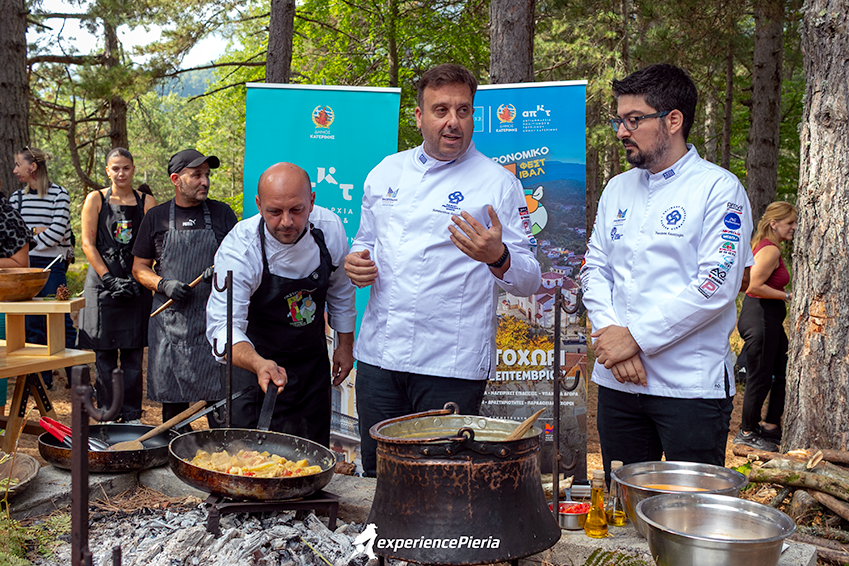
One of the things that caught my attention was the
smoked pork tenderloin from Vria, Pieria.
Chef Dimitris explained that pork production is part of the wider agricultural identity of Pieria,
while Vria has a particularly strong tradition connected with pork and meat.
There were also mushrooms paired with chestnut and balsamic,
local cheeses and other ingredients that made sense precisely because we were sitting
in the mountains, surrounded by the landscape where many of these flavours belong.
This is where a gastronomic festival can become more than a collection of dishes.
The landscape starts explaining the food.
When a Pastry Sheet Becomes Part of the Story
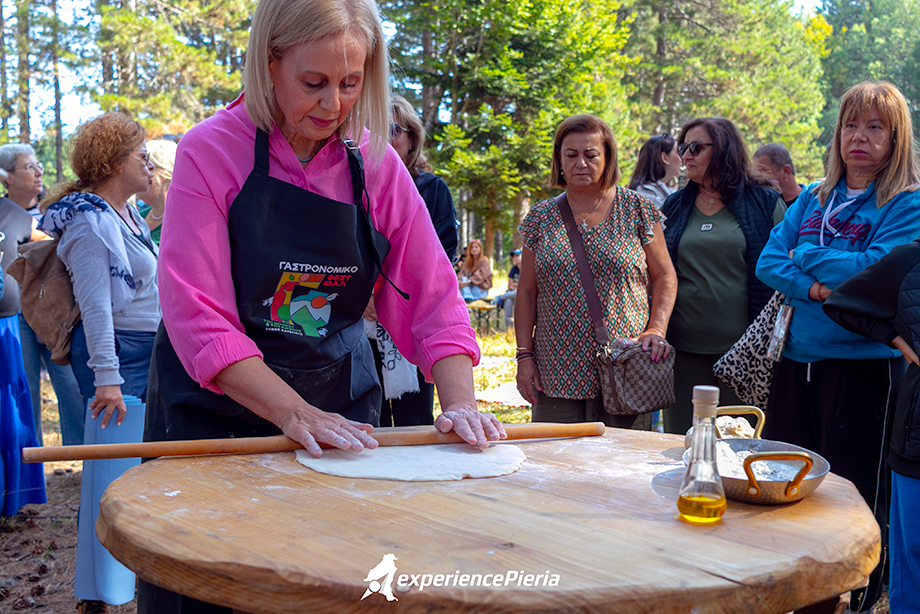
Another moment that stood out was watching
Elpida Charalampidou work with pastry.
She was opening the pastry sheet for a handmade mushroom pie.
The whole process was being filmed for social media,
turning something very familiar — hands, dough, flour and filling —
into a small live story.
The mushroom pie was served from a preparation that had already been made,
rather than waiting for a full pie to bake on the spot.
The galatopita had also been prepared earlier.
And honestly, that made sense.
A festival serving many people cannot always operate like a home kitchen.
Sometimes the important thing is allowing visitors to see part of the process,
understand the ingredients and then actually taste the result.
From Bobota to Kayanas: Familiar Flavours with a Local Accent
Some of the most interesting dishes were the ones that didn’t try to be complicated.
Bobota, for example, comes from a very simple tradition:
cornmeal, water and olive oil formed the basis of a food associated with poorer rural households.
Here it was presented with ingredients such as zucchini and feta.
There were also herb-filled babalokeftedes,
local cheeses, mushroom preparations, trachanas-based dishes and sweets.
And then there were the eggs.
What some people call kayanas, others call
strapatsada, while in many Greek kitchens it is simply
eggs with tomato.
The name and ingredients change from place to place,
but the idea remains wonderfully familiar.
Chef Dimitris and the team demonstrated the preparation,
including potatoes, tomato and seasoning.
This is one of the things I enjoy most about Greek food:
a recipe can travel from one village to another,
change slightly,
acquire another name,
and still feel unmistakably Greek.
And Then the Sweet Side of Elatochori
The breakfast and cooking demonstrations weren’t only about savoury food.
There were traditional sweets, yogurt, fruit and preparations using
walnuts, almonds, dried fruits and honey.
Among the flavours that caught my attention were
Napoleon, associated with Elatochori,
with pastry, cream, walnuts and cinnamon,
as well as baked apples from a wood-fired oven served with yogurt.
There was also almond halva with dried fruits, walnuts and almonds,
together with other sweets that turned the breakfast into something much closer
to a long, slow Greek table.
It was the kind of table where you realise that local gastronomy isn’t one single recipe.
It is a collection of memories, ingredients and small variations passed between people.
The People Were Part of the Experience
Food was only half the story.
There were babies, children, older people and dogs.
A baby slept peacefully on a blanket while people around enjoyed breakfast.
Most groups were surprisingly quiet.
People talked, ate and moved around,
but the forest seemed to influence the volume of the whole morning.
I remember a cheerful group of Cypriots in particular.
The musicality of their speech while they were discovering and appreciating the food
was almost another form of entertainment.
A Small Moment Between Content Creators
At some point I met Styliani, a content creator from Athens
who was also filming the festival for social media.
We were both doing what content creators often do:
looking for the next frame, the next detail, the next little story.
When my friend and I finished filming, she invited us to sit with her on a woven mat
and shared food from her plate.
No collaboration.
No briefing.
No business card moment.
Just three people who had been filming the same place
deciding to sit down and eat together.
Those are the moments I remember.
Food Tastes Different When the Forest Is Part of the Table
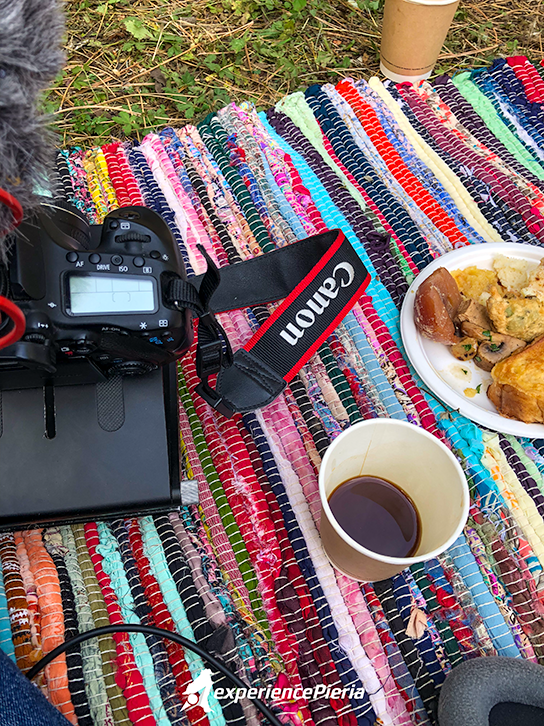
Sitting on a traditional woven mat with a plate of food,
a camera nearby and the trees around us,
I kept thinking about how different this experience would feel
if the same dishes were served inside a hotel ballroom.
The food might be identical.
The experience wouldn’t be.
This is why I think Pieria has something particularly interesting to explore:
gastronomy doesn’t have to be separated from the landscape.
The mountain can become part of the meal.
The sounds of the forest can become part of the table.
A local ingredient can tell you something about the place where you are eating it.
Could This Become a Different Kind of Experience in Pieria?
I left Elatochori thinking about something else.
What if the idea became smaller?
A local chef.
A handful of people.
Ingredients from nearby.
A table somewhere beautiful.
Cooking, tasting, talking and listening to the forest.
Not another large event.
Not a buffet.
Not something designed simply to be photographed.
Something more intimate, where the landscape becomes part of the meal.
This is one of the directions we are exploring through
Experience Pieria together with local people and other experience creators:
experiences where food, nature and people meet naturally.
Planning a Yoga, Pilates or Wellness Experience in Pieria?
The forest of Elatochori reminded me that Pieria can host much more than sightseeing.
If you are a
Yoga, Pilates, Breathwork, Wellness, Mindfulness or Movement instructor
from Greece or abroad and you are looking for a place to create a workshop,
retreat or nature-based experience in Pieria, we’d love to hear your idea.
You don’t necessarily need to have an existing business in Pieria.
You may simply have an idea you would like to bring to the mountain.
Through the Experience Pieria Experiences Directory,
we can explore suitable locations, local partners and ways to present your experience
to visitors looking for something more meaningful than a standard tour.
Explore Activities & Experiences in Pieria →
If You Want to Experience Something Similar
Events like this are a great excuse to discover Elatochori and the surrounding Pierian mountains,
but there are a few practical things worth knowing.
How to Get There
If you are staying in Elatochori and the location is suitable for walking,
walking can be a lovely way to arrive.
Otherwise, having your own vehicle gives you considerably more freedom.
A car, rental car, bicycle or taxi can make it easier to decide when to arrive,
when to leave and what else to visit during the day.
The free organised bus can be useful,
especially if you are coming from Katerini,
but a fixed return time can also mean that you leave before you are ready.
Bring Your Own Mat
If you are joining a Pilates, Yoga or similar activity in nature,
bring your own mat or at least a towel.
Mats were not provided at this activity.
Dress for the Mountain
Even when the morning starts warm, mountain weather can change.
An extra layer is a simple thing to carry and can make a big difference.
Leave Some Time for Elatochori Itself
Don’t treat the festival or any similar event as the whole destination.
Elatochori and the surrounding Pierian mountains are worth exploring at a slower pace.
If you are driving from Litochoro or the coast,
consider combining your visit with another village, viewpoint, monastery,
food stop or short walk instead of making the day only about the event.
The Sound I Remember
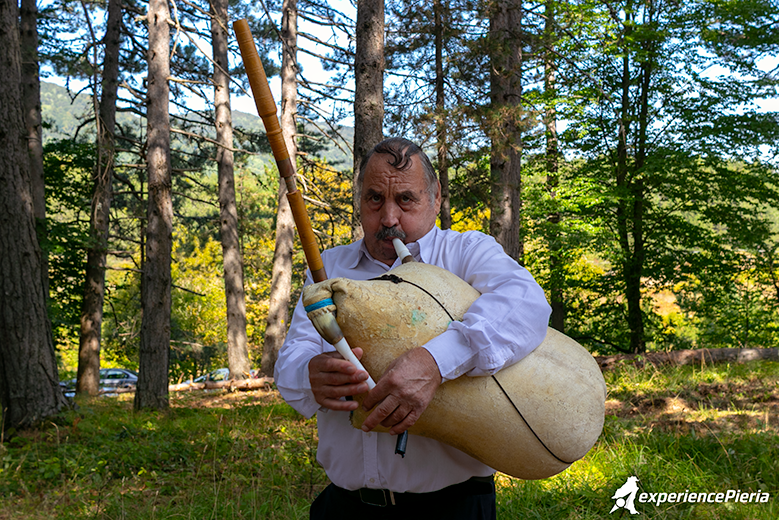
Eventually, the morning started to slow down.
Some people continued towards the forest walk.
Others simply stayed where they were,
enjoying the place a little longer.
And before leaving, I remember an older musician playing a
gaida (bagpipe).
It was probably my favourite goodbye.
Not because it was spectacular.
Because it felt completely connected to the place.
The food was disappearing.
The conversations were becoming quieter.
The forest was still there.
And the sound of the instrument stayed between the trees.
You Don’t Just Taste a Place. You Experience It.
So, what does Pieria taste like?
It tastes like mushrooms and chestnuts.
Like smoked pork from the mountains.
Like local cheese, honey and homemade pastry.
Like strawberries, lemon and mint.
Like Greek coffee with flower honey.
But it also tastes like a morning in the forest.
Like birds before breakfast.
Like breathing before eating.
Like a dog discovering your microphone.
Like strangers sharing food on a woven mat.
Like children, grandparents and dogs sitting under the trees.
Like traditional music saying goodbye.
And perhaps that is the real value of gastronomy in a destination.
It doesn’t only tell you what people eat. It tells you something about how a place lives.
That morning in Elatochori, I didn’t simply go to a food festival.
I experienced a small piece of Pieria.
And that’s the kind of story I want to keep telling through
Experience Pieria.
Travel Writer & Founder of Experience Pieria
Exploring Pieria & Greece one story at a time — sharing authentic places, people and tastes.
Continue Exploring Pieria
The Gastronomic Festival is one way to experience Elatochori and the Pierian mountains.
But Pieria has many more places, flavours, landscapes and experiences waiting to be discovered.
