
Religious Tourism in Pieria | Monasteries, Churches & Pilgrimage Sites
Religious Tourism in Pieria | Monasteries, Churches & Pilgrimage Sites
A journey through the monasteries, Byzantine churches, pilgrimage sites and sacred landscapes of Pieria, Greece.
Religious tourism in Pieria is not limited to a single monastery or pilgrimage route.
Across the region, churches, monasteries, chapels and places connected with local saints form a landscape where faith, history, architecture and nature often meet.
For some visitors, these places are destinations of pilgrimage and prayer. For others, they offer an opportunity to discover Byzantine heritage, traditional villages, local customs and some of the quieter landscapes around Mount Olympus.
This guide brings together some of the best-known religious and pilgrimage sites in Pieria — from the slopes of Mount Olympus to the villages around Katerini and the southern part of the region.
At a Glance
- Region: Pieria, Central Macedonia, Greece
- Focus: Monasteries, Byzantine churches, pilgrimage sites and local religious traditions
- Landscape: Mount Olympus, mountain villages, archaeological sites and the coast
- Best for: Pilgrims, history and culture travellers, photographers and visitors interested in local traditions
- Travel style: Religious heritage combined with nature, hiking, villages, archaeology and local life
A Sacred Landscape at the Foot of Mount Olympus
Pieria has a particularly diverse religious landscape because sacred places are spread across very different environments.
Some are Byzantine monuments. Others are monasteries, mountain chapels, village churches or pilgrimage sites associated with saints and local traditions.
Many are also connected with the landscape itself. Forest paths lead towards monasteries and chapels, while historic churches stand within villages that continue to celebrate their patron saints and religious festivals.
The result is a form of cultural travel where a visit to a religious monument can easily become part of a wider day exploring Pieria.
The Old Monastery of Agios Dionysios
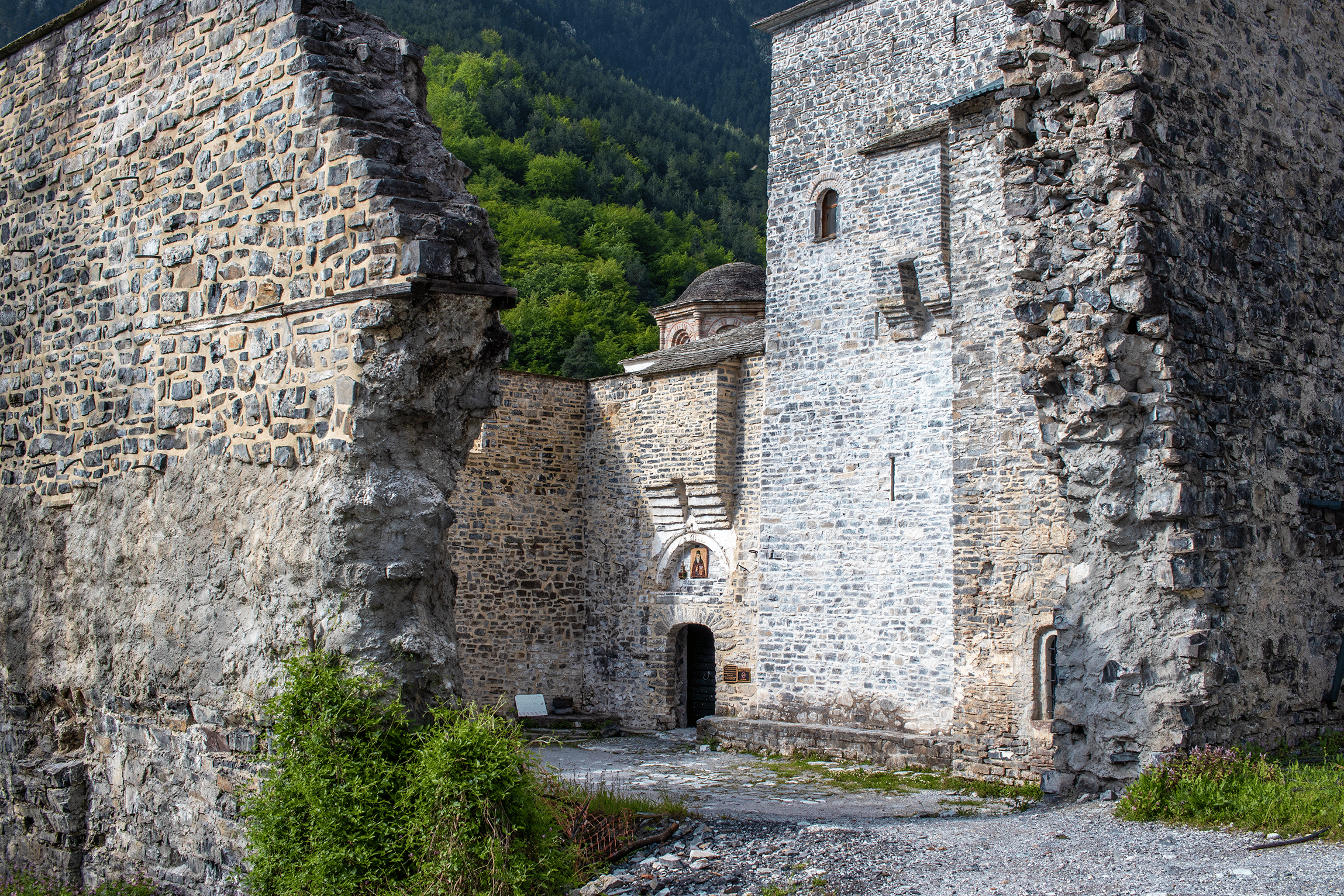
One of the most important religious landmarks of Pieria is the Old Monastery of Agios Dionysios, on Mount Olympus near Litochoro.
Founded in the 16th century by Saint Dionysios of Olympus, the monastery became an important centre of Orthodox monastic life on the mountain.
Its location is part of what makes the site special. The monastery is surrounded by the forests and dramatic landscape of Olympus, and its history is closely connected with the spiritual tradition of the mountain.
Today, a visit to the old monastery can be combined with hiking and exploring the wider landscape of Mount Olympus.
Discover the Old Monastery of Agios Dionysios
The New Monastery of Agios Dionysios
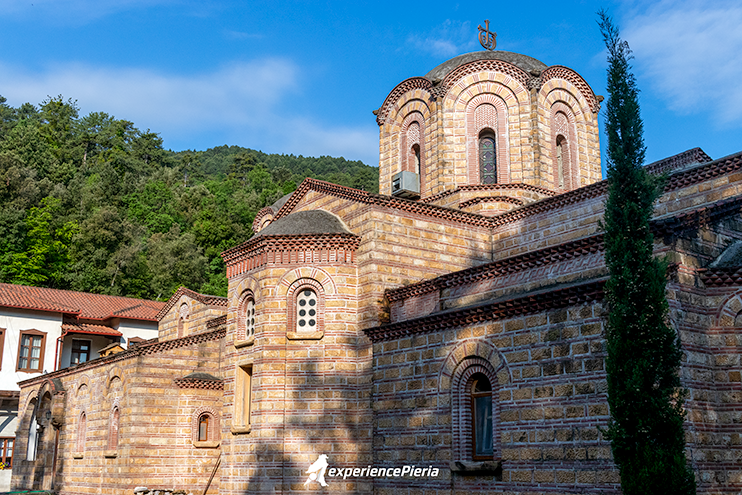
The New Monastery of Agios Dionysios continues the monastic tradition associated with the saint and Mount Olympus.
The new monastery became the successor to the historic monastery on Olympus after the old monastery suffered severe destruction during the 20th century.
Together, the old and new monasteries tell a larger story about Saint Dionysios, Orthodox monasticism and the spiritual history of Mount Olympus.
The feast of Saint Dionysios of Olympus on 23 January is an important religious occasion in Pieria, where the saint is particularly honoured.
The Holy Cave of Agios Dionysios

Higher on Mount Olympus, the Holy Cave of Agios Dionysios is associated with the ascetic life of the saint.
Unlike a conventional monument, the cave is experienced as part of the mountain itself. The surrounding rock, forest and paths create a very different atmosphere from the churches and monasteries found in the villages below.
For travellers, the cave can become part of a wider mountain experience combining religious heritage, walking and the landscape of Olympus.
Discover the Holy Cave of Agios Dionysios
Panagia Kontariotissa
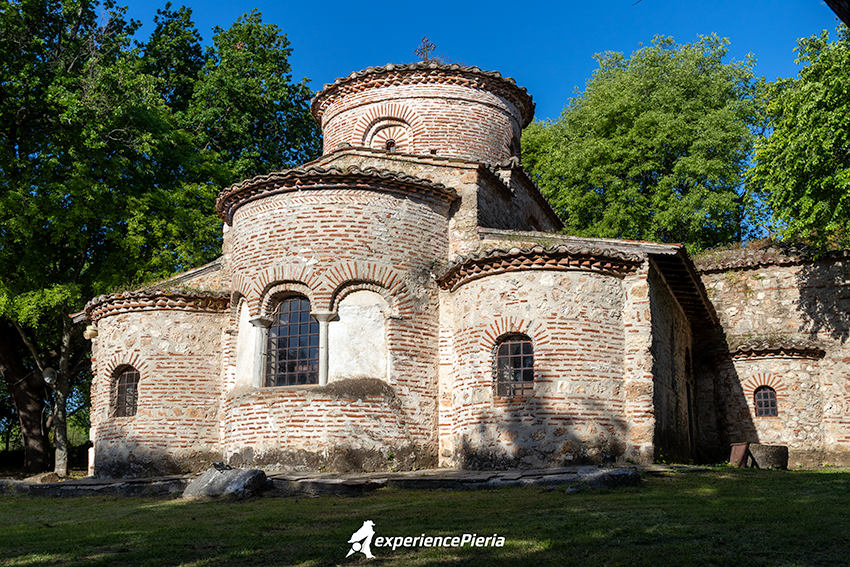
The Byzantine Church of Panagia Kontariotissa, dedicated to the Dormition of the Virgin Mary, is one of the most important Byzantine monuments in Pieria.
Located about one kilometre from Kontariotissa, the church dates to the 11th century and is considered the oldest Byzantine monument in Pieria. Its architecture, dome, surrounding portico and surviving decorative elements make it an important stop for anyone interested in the region’s Byzantine heritage.
There is also a fascinating local tradition about the name Kontariotissa. According to local storytelling, the area was associated with the cutting of trees for the kontaria — spear shafts or poles — supposedly connected with the army of Alexander the Great.
This story should be understood as a local tradition rather than established historical evidence. What is historically documented is the ancient material incorporated into the Byzantine church, which the Diocese connects with the ancient Macedonian city of Dion.
The church therefore brings together several layers of Pieria’s history: ancient Macedonia, Byzantine Christianity and modern local memory.
Discover Panagia Kontariotissa
Agia Triada of Vrontou

At the foothills of Mount Olympus, about four kilometres from Vrontou, stands the historic church of Agia Triada — Holy Trinity.
The church dates to the 14th century and was built on a rock on a steep mountain slope at an altitude of around 400 metres.
According to the Diocese of Kitros, Katerini and Platamon, the site originally functioned as a small monastic settlement, with traces of hermitages found in the surrounding area. Today it is a chapel and pilgrimage site.
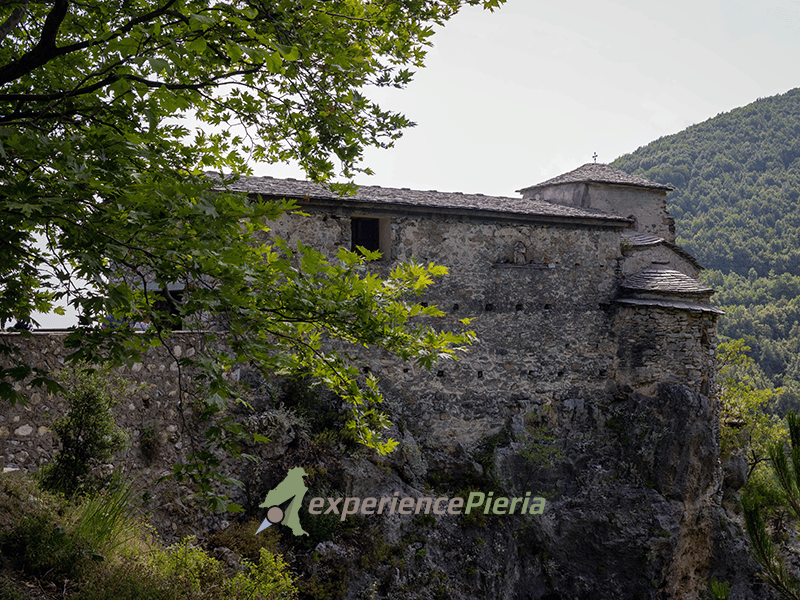
Its unusual position above the forest is part of the experience. Agia Triada is a place where religious heritage and the landscape of northern Mount Olympus become inseparable.
Agia Kori of Vrontou
Another well-known pilgrimage destination in the Vrontou area is Agia Kori.
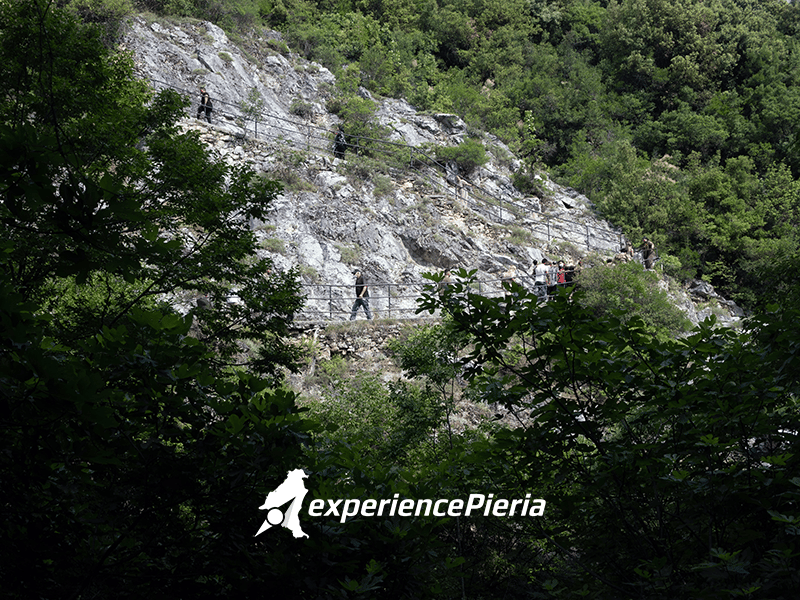
The site combines religious tradition with a natural setting of forest, water and mountain paths. It is one of the places where a pilgrimage experience can naturally become a walk through the landscape.
Agia Kori is officially included among the pilgrimage destinations of the Diocese of Kitros, Katerini and Platamon.
Osios Ephraim the Syrian Monastery
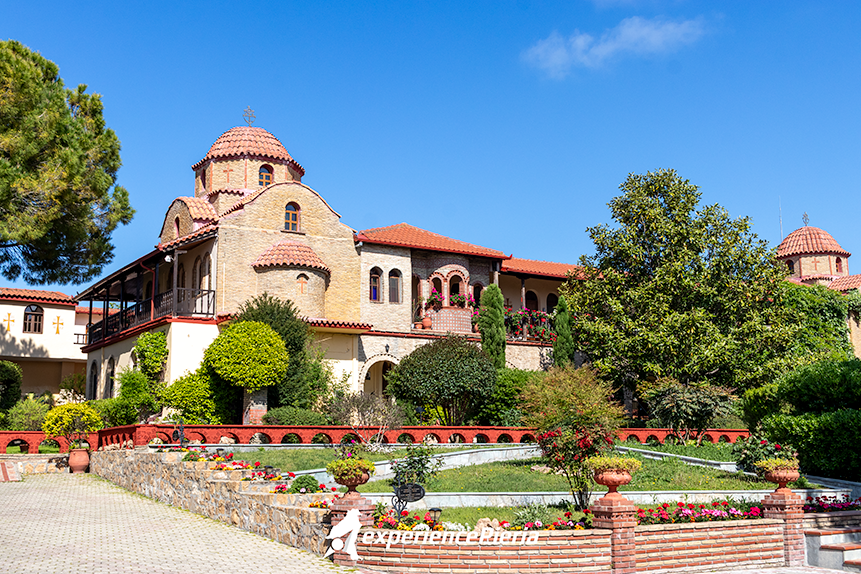
Near Kontariotissa, on a hill overlooking the surrounding landscape, stands the Holy Monastery of Osios Ephraim the Syrian.
The monastery was founded in 1983 and became part of the Diocese of Kitros, Katerini and Platamon. Its main church was inaugurated in 2000 and is dedicated to Osios Ephraim and the Virgin Mary as Zoodochos Pigi.
The monastery celebrates its feast on 28 January, the feast day of Osios Ephraim the Syrian.
Its location near Kontariotissa makes it particularly easy to combine with a visit to Panagia Kontariotissa, ancient Dion and the surrounding villages.
Agios Kosmas the Aetolian in Ano Milia
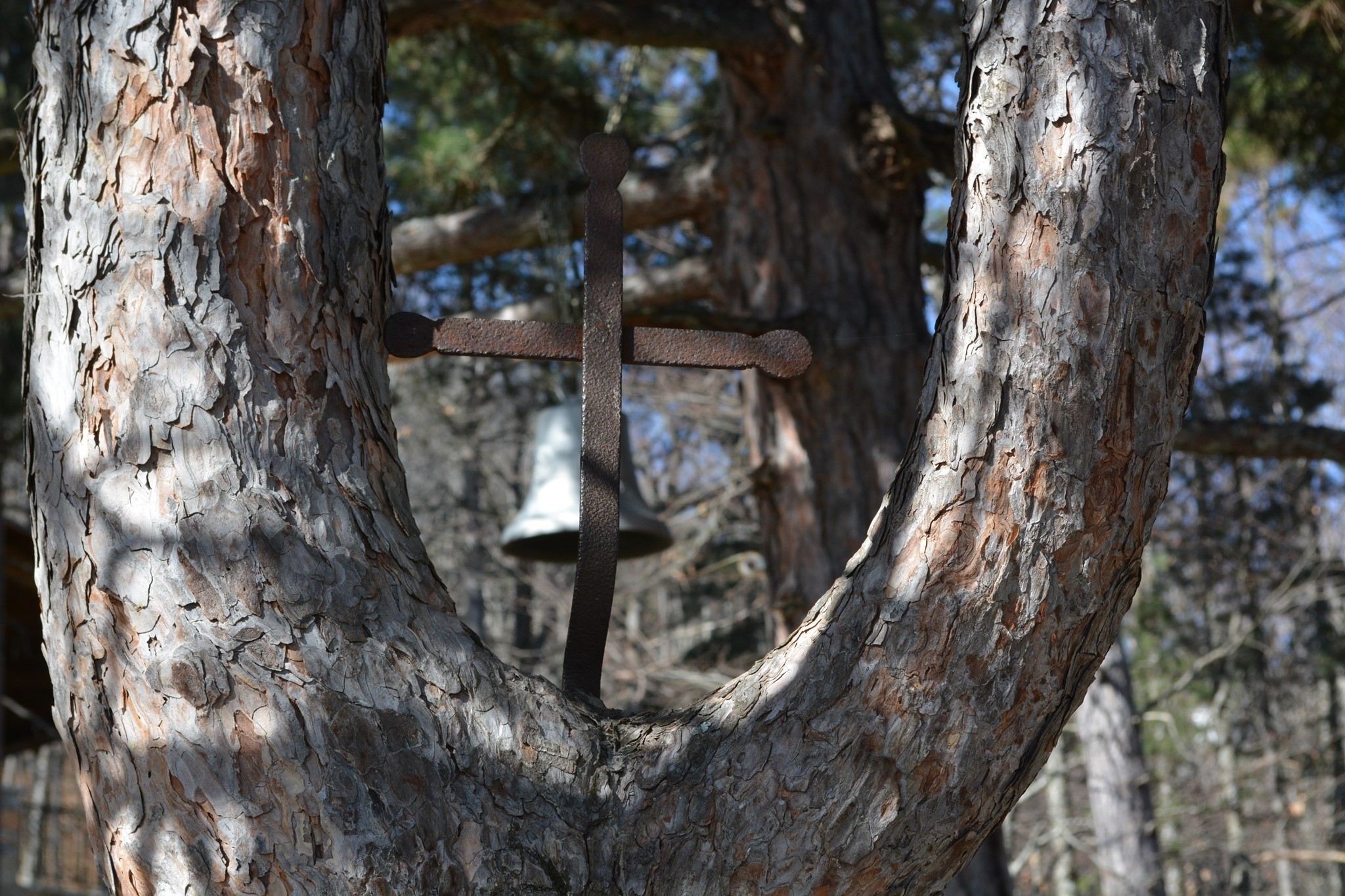
In the mountain village of Ano Milia, one of Pieria’s most distinctive religious sites is connected with the passage of Saint Kosmas the Aetolian.
According to the local tradition recorded by the Diocese, Saint Kosmas visited Ano Milia during his missionary journeys through the Pierian mountains and placed an iron cross in the fork of a pine tree.
The cross became a lasting memorial of his passage through the area. A small church dedicated to Saint Kosmas was later built beside the tree, and the site continues to be a place of pilgrimage.
The Diocese records that the church was inaugurated in 2003 and that a feast is held there each year.
This is one of the most interesting examples in Pieria of how a religious site can preserve not only a building, but also a story, a landscape and a physical connection with local memory.
Agios Georgios Monastery in Ritini
The historic Monastery of Agios Georgios in Ritini is another important religious monument in the mountains of Pieria.
The monastery is connected with the religious history of the surrounding villages and remains part of the wider network of monasteries and sacred places maintained by the Diocese.
Ritini also provides an opportunity to combine religious heritage with the forests, villages and mountain landscapes of central Pieria.
Panagia Petra Monastery
The Monastery of Panagia Petra belongs to the historic monastic landscape of Mount Olympus and is associated with important figures in the religious history of the region.
Its mountain setting illustrates a recurring feature of Pieria’s religious heritage: monasteries were not separated from the landscape around them. Forests, springs, paths and remote mountain locations were part of the experience of monastic life itself.
Religious Heritage Around Ancient Dion
Pieria’s Christian history extends beyond its monasteries and mountain churches.
Around ancient Dion, visitors can find important remains connected with the early Christian and Byzantine history of the region, including basilicas and an episcopal complex.
This creates an especially interesting historical sequence for visitors: the ancient sanctuary landscape of Dion, followed by the development of Christian communities in the same wider area.
A visit to the religious monuments around Dion can therefore be combined with the
Archaeological Park of Dion
and the Archaeological Museum of Dion.
Ancient Pydna & the Passage of Saint Paul
The religious heritage of Pieria also includes places associated with the early Christian tradition and the journeys of Saint Paul.
The Diocese lists the Monument of the Passage of Apostle Paul and Ancient Pydna, traditionally associated with the departure point of his journey, among the pilgrimage destinations of Pieria.
These sites add another dimension to a religious journey through the region, connecting Pieria with the wider history of early Christianity in Macedonia.
Agios Athanasios in Ano Skotina
The old settlement of Ano Skotina preserves important examples of traditional mountain architecture and religious heritage.
The historic church of Agios Athanasios is part of this older village landscape, where churches and chapels were closely connected with everyday community life.
A visit can easily be combined with the old village, mountain paths, chestnut forests and the wider landscapes of southern Olympus.
Agios Panteleimon in Paleos Panteleimonas
The historic mountain village of Paleos Panteleimonas is also home to the Church of Agios Panteleimon.
Here, religious heritage is part of the traditional village itself, alongside stone houses, narrow paths, old squares and views towards the Aegean.
It is a good example of how religious tourism in Pieria does not always mean travelling to a remote monastery. Sometimes the church is simply part of the living structure of a historic village.
Other Religious Monuments Across Pieria
The sites above are only some of the best-known destinations. The official catalogue of the Holy Metropolis of Kitros, Katerini and Platamon includes many more monasteries, churches, chapels and pilgrimage sites throughout the region.
- Agios Georgios of Korinos
- Agios Athanasios Monastery near Kolindros
- Monastery of Saints Joachim and Anna
- Monastery of Panagia Makryrachi
- Prophet Elias of Olympus
- Agios Nikolaos of Old Vrontou
- Agios Nikolaos of Old Elatochori
- Church of the Dormition of the Virgin Mary in Old Skotina
- Agios Georgios of Mesaia Milia
- Agios Dimitrios of Dion
- Agia Paraskevi of Kontariotissa
The official catalogue of religious monuments is maintained by the
Holy Metropolis of Kitros, Katerini and Platamon
.
Religious Festivals & Local Traditions
Religious heritage in Pieria is not only found in buildings.
It is also experienced through feast days, processions, pilgrimages, Epitaphios traditions, village celebrations and local customs.
During important feast days, churches and monasteries become meeting points for the local community. Religious ceremonies may be accompanied by traditional food, hospitality and gatherings that reveal another side of village life.
For travellers interested in experiencing this living heritage, it is worth checking local programmes before visiting, especially around important feast days.
How to Explore Religious Pieria
Religious tourism works particularly well in Pieria when it is combined with other experiences.
- Litochoro & Mount Olympus: Agios Dionysios, the Holy Cave and the mountain trails.
- Kontariotissa & Dion: Panagia Kontariotissa, Osios Ephraim and the archaeological heritage of Dion.
- Vrontou: Agia Triada, Agia Kori and the forests of northern Olympus.
- Ano Milia: The pilgrimage site of Agios Kosmas and the mountain villages of the Pieria range.
- Ano Skotina: Historic churches, traditional village architecture, chestnut forests and mountain landscapes.
- Paleos Panteleimonas: Village heritage, Agios Panteleimon, Platamon Castle and the southern coast.
Practical Information for Visitors
- Dress respectfully: Modest clothing is appropriate when entering churches and monasteries. Specific requirements can vary by site.
- Check opening arrangements: Not every church or monastery is open continuously. Some places may have specific visiting hours or access mainly during services and feast days.
- Respect religious services: If a service is taking place, avoid photography, conversation or movement that could disturb worshippers.
- Ask before photographing: Photography rules may differ, particularly inside monasteries and churches.
- Mountain sites: Some religious destinations require walking on uneven paths. Appropriate footwear is recommended.
Religious Tourism in Pieria Is Also About Living Heritage
Pieria is often introduced through Mount Olympus, its beaches and ancient Dion. But between the mountain and the sea lies another layer of the region: centuries of Christian history, monastic life, village churches, pilgrimage traditions and local memory.
Some of these places are monumental. Others are surprisingly small — a chapel in the forest, a cross on a tree, an old church in a mountain village.
And perhaps that is what makes religious tourism in Pieria interesting. You do not always have to look for a grand monument. Sometimes the story is hidden in a path, a village, a mountain or a tradition that has been passed from one generation to another.
Continue Exploring Pieria
The sacred landscape is only one part of the story.
From here, you can continue towards Mount Olympus, explore ancient Dion, walk through traditional mountain villages, discover local traditions or follow the coastline towards the Aegean.
Explore Pieria at your own pace:
Explore Pieria
