
Description
The Holy Cave of Agios Dionysios, also known as the Holy Cave of Saint Dionysios, is a historic place of prayer and pilgrimage on Mount Olympus, inside the Enipeas Gorge in Pieria, Greece.
The cave is closely connected with Saint Dionysios of Olympus, who lived as a hermit here after arriving on Mount Olympus in 1542. Today, the cave contains a small chapel and remains one of the most distinctive religious sites along the Enipeas Gorge route.
A hermitage beneath the rock
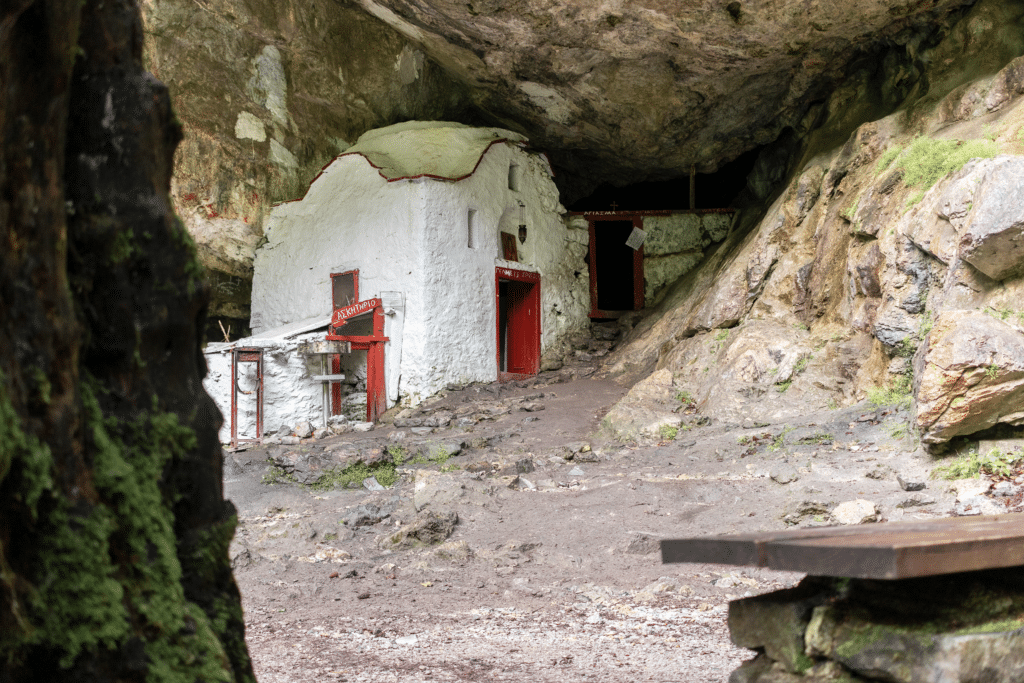
The Holy Cave is located beneath a large overhanging rock, in a secluded part of the Enipeas Gorge. Saint Dionysios used the cave as a place of ascetic retreat and prayer, seeking the solitude of the mountain before returning to his spiritual work at the monastery he founded.
The site preserves the character of a natural hermitage. The cave and its small chapel are integrated directly into the rocky landscape, creating a very different experience from visiting a conventional church or monastery.
The chapel inside the cave
A small chapel is built inside the cave and forms the spiritual centre of the site. The cave is therefore both a natural feature of Mount Olympus and a place of Christian pilgrimage connected with the life of Saint Dionysios.
The Holy Cave is one of the places associated most directly with the personal spiritual life of the saint, alongside the Old and New Monastery of Agios Dionysios.
Located in the Enipeas Gorge
The cave lies in the Enipeas Gorge, one of the best-known natural landscapes of Mount Olympus.
It forms part of the wider Litochoro–Prionia route and the E4 trail. The area combines dense forest, the Enipeas River, waterfalls, wooden bridges, rocky slopes and religious landmarks.
The Holy Cave can be reached by hiking through the Enipeas Gorge, while visitors who drive towards Prionia can also approach the area by road and then continue on foot.
From the Old Monastery to the Holy Cave
The Holy Cave is close to the Old Monastery of Agios Dionysios. From the parking area near the Old Monastery, the cave can be reached on foot in approximately 15–20 minutes, depending on pace and trail conditions.
The Municipality of Dion-Olympus describes the cave as approximately 20 minutes on foot from the Old Monastery, while other local tourism sources also describe it as an easy walking connection from the monastery.
This makes it possible to combine the Old Monastery and Holy Cave in the same visit.
Holy Water of Saint Dionysios
The area around the cave is also associated with holy water, or Agiasma, connected with the religious tradition of Saint Dionysios.
Visitors and pilgrims come to the site not only to see the cave and chapel but also to experience this spiritual place and its natural surroundings.
A place along the Mount Olympus hiking route
The Holy Cave is not an isolated attraction. It is part of the wider hiking experience of Mount Olympus.
The route between Prionia, the Holy Cave, the Old Monastery and the Enipeas Gorge offers a combination of nature, hiking and religious heritage.
The section from Prionia towards the Holy Cave is also part of the wider E4 route between Prionia and Litochoro. The route is surrounded by forest and follows the landscape of the Enipeas Gorge.
For visitors who do not want to undertake a long mountain hike, driving to the Old Monastery and walking from the monastery to the cave provides a shorter way to experience this particular part of Mount Olympus.
📍 Enipeas Gorge, Mount Olympus, Pieria, Greece
⛰️ Mount Olympus
🙏 Pilgrimage Site
⛪ Small Chapel Inside the Cave
🕯️ Hermitage of Saint Dionysios
💧 Holy Water / Agiasma
🥾 Enipeas Gorge Hiking
📍 Approximately 15–20 minutes on foot from the Old Monastery
FAQ
What is the Holy Cave of Agios Dionysios?
The Holy Cave of Agios Dionysios is a historic cave and place of prayer on Mount Olympus where Saint Dionysios lived as a hermit. A small chapel is built inside the cave.
Where is the Holy Cave of Agios Dionysios?
The cave is located inside the Enipeas Gorge on Mount Olympus, in Pieria, Greece, close to the Old Monastery of Agios Dionysios.
What is the connection between Saint Dionysios and the cave?
Saint Dionysios of Olympus used the cave as a place of ascetic retreat and prayer after settling on Mount Olympus in 1542. The cave is therefore directly associated with his spiritual life.
When did Saint Dionysios live in the cave?
Saint Dionysios settled on Mount Olympus in 1542 and practised as a hermit in the cave beneath the rock.
Is there a church inside the Holy Cave of Agios Dionysios?
Yes. A small chapel is built inside the cave and forms the main religious space of the site.
Is the Holy Cave of Agios Dionysios a pilgrimage site?
Yes. The cave is a place of pilgrimage associated with Saint Dionysios and attracts visitors interested in Orthodox religious heritage, spirituality and the history of Mount Olympus.
Where is the Holy Cave in relation to the Old Monastery?
The Holy Cave is close to the Old Monastery of Agios Dionysios. From the parking area near the Old Monastery, it takes approximately 15–20 minutes to reach the cave on foot, depending on walking pace and trail conditions.
Can you walk from the Old Monastery to the Holy Cave?
Yes. The cave is accessible on foot from the Old Monastery. The walk takes approximately 15–20 minutes according to local descriptions.
Is the walk from the Old Monastery to the Holy Cave difficult?
The walk is relatively short, but it is a mountain trail rather than a paved urban path. Visitors should wear suitable walking shoes and take care on uneven or wet sections.
Can you drive directly to the Holy Cave of Agios Dionysios?
There is road access towards the Mount Olympus area and Prionia, but the Holy Cave itself is reached on foot. A practical option is to drive to the Old Monastery area and continue to the cave by walking.
How do you get to the Holy Cave from Litochoro?
From Litochoro, follow the road towards Prionia and Mount Olympus. The Old Monastery of Agios Dionysios is located along this route, and the Holy Cave can then be reached on foot from the monastery. The cave is also accessible as part of the Enipeas Gorge hiking route.
How far is the Holy Cave from Litochoro?
The cave is located in the Mount Olympus area above Litochoro, inside the Enipeas Gorge. The exact walking distance depends on the route used. Visitors approaching by car can drive towards Prionia and then walk to the cave.
Is the Holy Cave on the Litochoro–Prionia hiking trail?
Yes. The Holy Cave forms part of the wider E4 hiking route through the Enipeas Gorge between Litochoro and Prionia.
Can you visit the Holy Cave from Prionia?
Yes. The cave can be reached as part of the hiking route from Prionia towards Litochoro through the Enipeas Gorge. The route also connects with the Old Monastery of Agios Dionysios.
How long does it take to walk from Prionia to the Holy Cave?
The Holy Cave is part of the Prionia–Litochoro hiking route, but the exact time depends on the specific route and starting point. Visitors planning only a short visit should consider approaching the cave from the Old Monastery rather than undertaking the entire Enipeas route.
What can you see at the Holy Cave?
Visitors can see the natural rock formation, the small chapel inside the cave and the surrounding landscape of the Enipeas Gorge. The site also provides a direct connection with the hermit life of Saint Dionysios.
Is there holy water at the Holy Cave of Agios Dionysios?
The site is associated with holy water, or Agiasma, connected with Saint Dionysios and the religious tradition of the cave.
Can you drink the holy water at the Holy Cave?
The site is traditionally associated with holy water and visitors may encounter the Agiasma. Visitors should follow local religious guidance regarding drinking or collecting water.
Is the Holy Cave of Agios Dionysios open to visitors?
The cave is a recognised visitor and pilgrimage site and can be reached on foot. There is no standard published daily opening schedule comparable to a conventional museum or church. Access can depend on trail conditions and local circumstances.
Are there opening hours for the Holy Cave?
There is no reliable regular published opening timetable for the cave. Because it is an open mountain pilgrimage site rather than a conventional museum, visitors should plan their visit according to daylight and current trail conditions.
Is the Holy Cave free to visit?
There is no general entrance ticket for visiting the Holy Cave. It is a pilgrimage and natural site within the Mount Olympus landscape.
Can you visit the Holy Cave without hiking for several hours?
Yes. Visitors who want to avoid the longer Litochoro–Prionia hike can drive towards the Old Monastery of Agios Dionysios and then walk approximately 15–20 minutes to the cave.
Is the Holy Cave suitable for families?
The short approach from the Old Monastery can be suitable for families accustomed to walking on mountain trails. However, the route includes uneven terrain and visitors should supervise children carefully around rocks, slopes and the cave entrance.
What should you wear to visit the Holy Cave?
Comfortable walking shoes are recommended. Because the cave is in a mountain environment, visitors should also consider weather conditions, water and appropriate clothing for the season.
Can you visit the Holy Cave in winter?
Access conditions can be affected by winter weather, rain, snow or ice on the Mount Olympus roads and trails. Check local conditions before travelling during the winter months.
What is the Enipeas Gorge?
The Enipeas Gorge is one of the most important natural landscapes of Mount Olympus. The gorge contains the Enipeas River, forest, waterfalls, wooden bridges and hiking trails, including the route connecting Litochoro with Prionia.
What other places can you visit near the Holy Cave?
The Old Monastery of Agios Dionysios is the closest major religious site and can be combined with the cave in the same visit. The wider Enipeas Gorge, its waterfalls and hiking trails are also nearby.
Can you visit the Old Monastery and Holy Cave on the same day?
Yes. The two sites are close to each other and can easily be combined. The Holy Cave is approximately 15–20 minutes on foot from the Old Monastery parking area.
What is the difference between the Holy Cave and the Old Monastery of Agios Dionysios?
The Old Monastery is the historic monastery founded by Saint Dionysios in 1542. The Holy Cave is the natural hermitage where Saint Dionysios practised as an ascetic. They are separate sites but are closely connected through the saint's life.
Is the Holy Cave connected with the New Monastery of Agios Dionysios?
Yes. The Holy Cave, Old Monastery and New Monastery are all connected with the life and monastic tradition of Saint Dionysios of Olympus, but they are three different locations.
Is the Holy Cave of Agios Dionysios worth visiting?
The cave offers a rare combination of religious heritage and natural landscape. Visitors can enter a place directly associated with the ascetic life of Saint Dionysios while experiencing the forest, rocks and Enipeas Gorge of Mount Olympus.
What makes the Holy Cave of Agios Dionysios special?
The cave is not simply an archaeological or religious monument. It is a natural hermitage where Saint Dionysios lived and prayed, with a small chapel built directly into the rock. Its setting inside the Enipeas Gorge makes the religious experience closely connected with the landscape of Mount Olympus.


Add a review