
Burning Cedar Fires in Litochoro, Pieria | A Greek Carnival Tradition
Burning Cedar Fires in Litochoro, Pieria | A Greek Carnival Tradition
Discover the cedar fires of Litochoro, a distinctive Carnival tradition where fire, smoke, community and local memory come together at the foot of Mount Olympus.
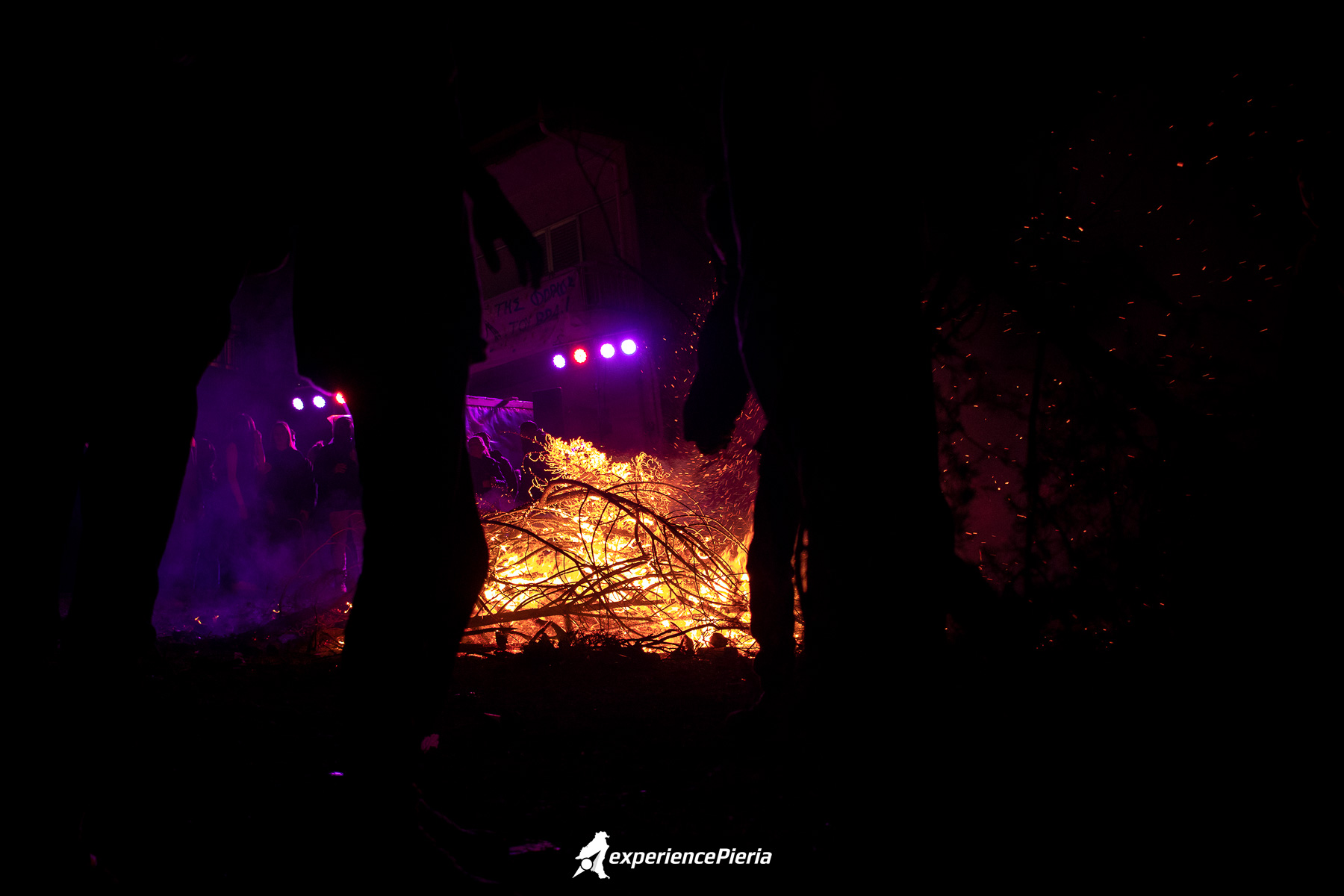
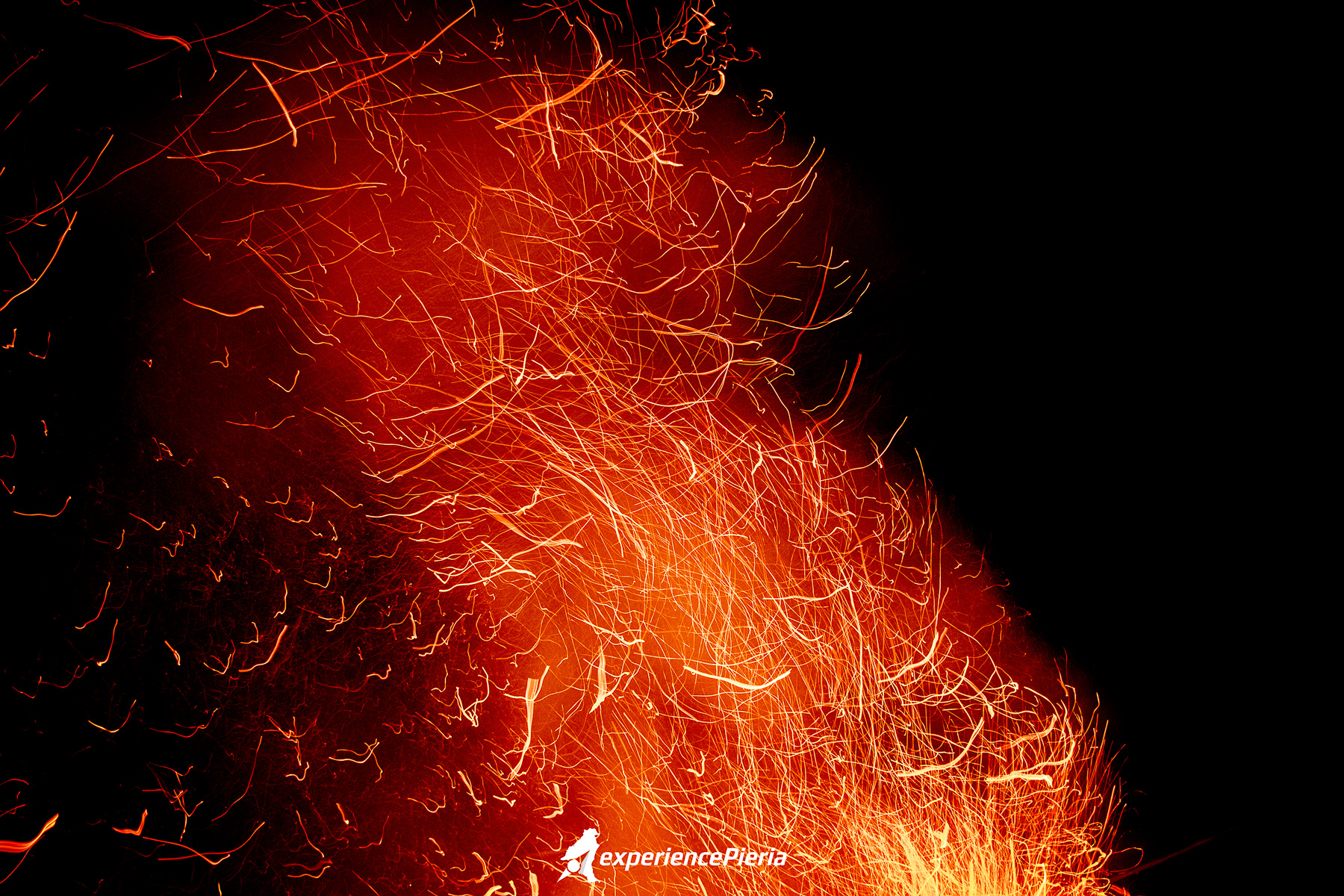
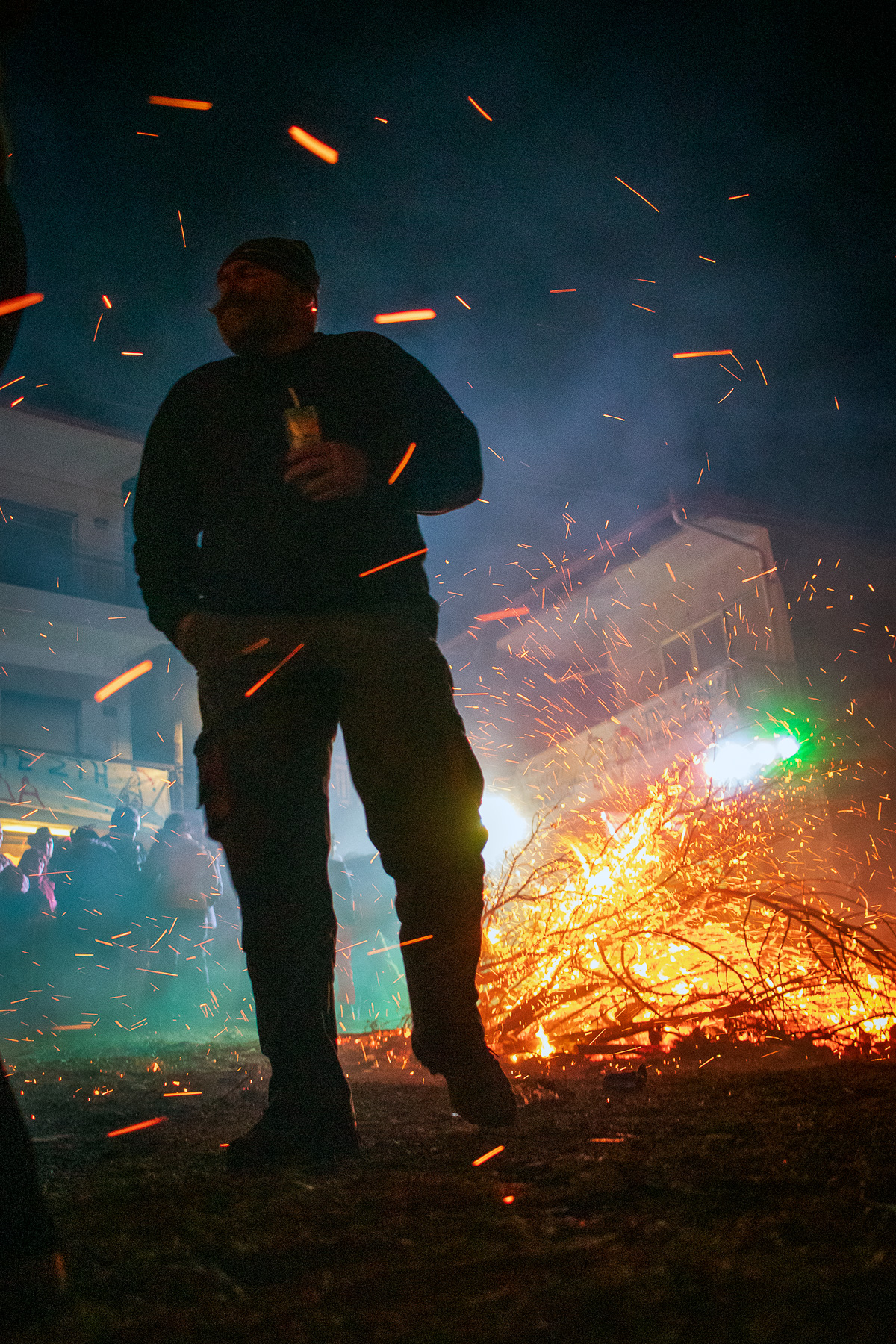
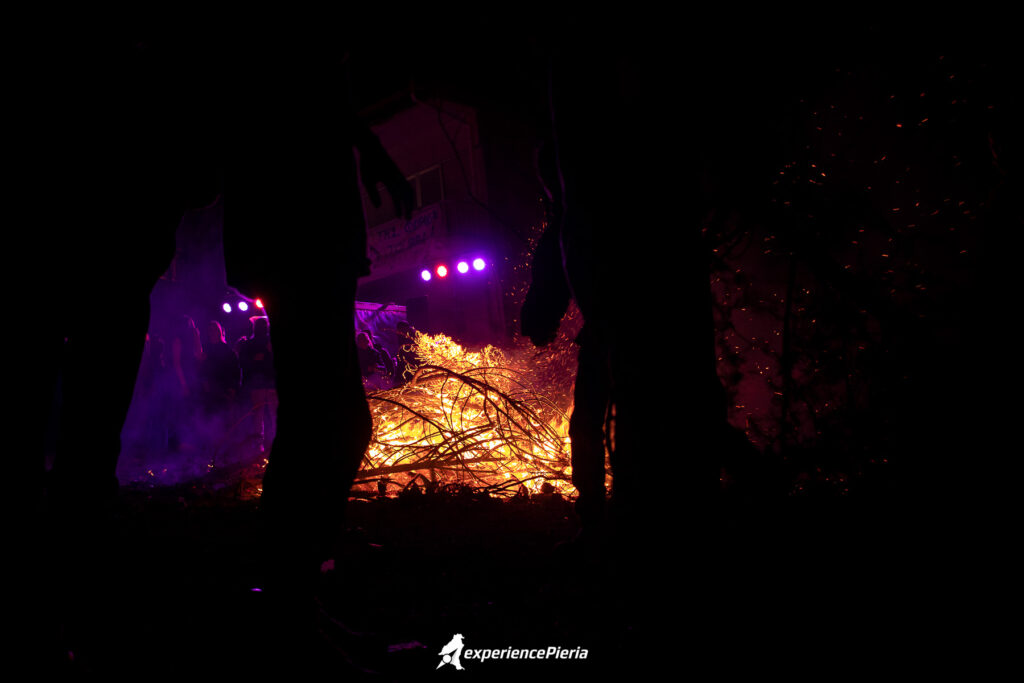
During the Carnival season, the neighbourhoods of Litochoro gather around large cedar fires that turn the winter night into a scene of firelight, smoke, music and community.
Known locally through the neighbourhoods called Bairia, the tradition is one of the distinctive customs of Carnival in Litochoro, at the foot of Mount Olympus.
It is easy to see the fires simply as a spectacular part of Carnival.
But there is more to them.
The cedar, the flame, the smoke and the gathering of people create a ritual language that reaches much further back than the modern Carnival celebration.
Burning Cedars in Litochoro at a Glance
- Where: Litochoro, Pieria, at the foot of Mount Olympus.
- When: during the Carnival period, culminating around Carnival Sunday.
- What happens: neighbourhood groups gather and prepare cedar wood before lighting their fires.
- Where it happens: in the local Bairia neighbourhoods of Litochoro.
- What makes it special: fire, smoke, music, community and a tradition passed between generations.
- Symbolism: fire and rising smoke can be understood through ideas of purification, offering, renewal and communication with the sacred.
- Best for: travellers interested in Greek culture, folklore, photography and living traditions.
What Is the Cedar Fire Tradition in Litochoro?
The burning of the cedars is one of the characteristic Carnival traditions of Litochoro.
During the Carnival period, the town’s neighbourhood communities — known as Bairia — prepare their cedar fires. The tradition culminates with the lighting of the fires, bringing people together around the flames.
Local descriptions of Carnival in Litochoro place the burning of cedars in the neighbourhoods at the centre of the celebrations. The tradition is followed by the celebrations of Clean Monday, including kite flying and traditional Lenten food.
For visitors, however, the experience begins long before the fire is lit.
The preparation, the gathering of the wood, the people coming together and the anticipation are all part of the tradition.
The Bairia: Neighbourhoods, Rivalry & Community
The cedar fires belong to the neighbourhoods of Litochoro.
The Bairia prepare their own fires, creating a friendly rivalry between different parts of the town.
The competition gives the tradition a playful character. Each neighbourhood wants its fire to be impressive and to remain alive through the night.
But beneath the rivalry is something more meaningful: collective participation.
The preparation of the fire becomes a community activity involving people of different ages. Older residents carry memories of earlier celebrations, while younger generations become part of the custom by taking part themselves.
This is how a tradition remains alive — not only through written records, but through people continuing to do it.
Passing the Tradition From Generation to Generation
One of the most important aspects of a living tradition is the way knowledge moves from one generation to the next.
In Litochoro, the cedar fires are not simply something people come to watch. They are prepared by the community.
Young people learn through participation, while older generations carry memories of how the custom was celebrated in earlier times.
The details may change. The atmosphere may change. The way people celebrate may change.
But the central act remains:
Gather the wood. Build the fire. Gather together.
Why Cedar?
The use of cedar gives the tradition a particularly powerful sensory character.
In ancient Greek ritual practice, fragrant wood was used in sacred fires. Ancient sources associate the burning of sweet-smelling wood, including cedar, with offerings and the ritual enjoyment of fragrance by the gods.
The important element was not simply the wood itself, but what happened when it burned: fragrance and smoke became part of the ritual experience.
This gives the modern cedar fire an intriguing connection with a much older Greek ritual vocabulary.
We should not, however, describe the Litochoro custom as a direct survival of a specific ancient ceremony. There is no need to make such a claim to appreciate its depth.
What we can say is that the symbolism of aromatic wood, fire, smoke, offering and purification has very ancient roots in Greek religious culture.
When Smoke Becomes a Prayer
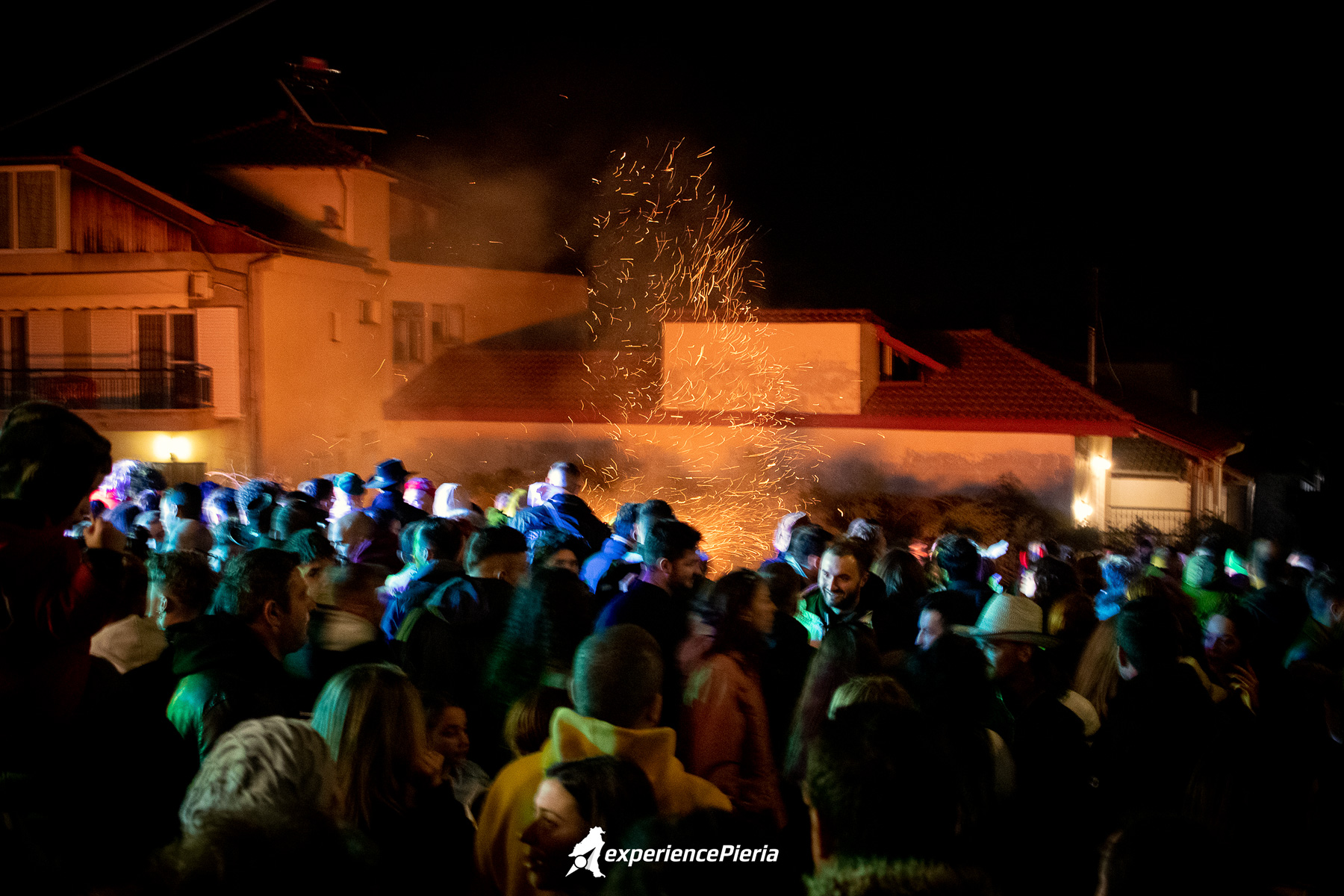
There is something ancient about watching smoke rise from a fire.
In Greek religious thought, fragrant smoke had a special ritual role. It could create an atmosphere associated with the divine, while the movement of smoke upwards could be understood as a symbolic connection between the human and the divine.
In this sense, the smoke of the cedar fire can be read symbolically as an offering rising towards the sky.
A prayer.
A wish.
A gesture of purification.
A way of leaving something behind.
This is not meant to suggest that every person standing around a Litochoro fire today consciously performs an ancient religious rite. The meaning of traditions changes over time.
But symbols can survive even when their original explanations change.
The wood becomes fire. The fire becomes smoke. The smoke rises.
And that simple movement carries an extraordinary symbolic power.
Ancient Ritual Echoes & Dionysian Traditions
The relationship between Greek Carnival traditions and the ancient world has interested scholars for more than a century.
Early twentieth-century research in northern Greece, Thessaly and southern Macedonia documented Carnival customs and examined their possible relationship with older ritual traditions associated with Dionysus.
Such comparisons are useful because a number of recurring themes appear across different periods: masks, music, procession, communal celebration, temporary changes in everyday behaviour, fertility and renewal.
But it is important not to turn comparison into certainty.
The modern Carnival traditions of Greece developed through many centuries and were shaped by both older cultural practices and the Christian calendar.
So rather than saying that the cedar fires of Litochoro are simply an unchanged Dionysian ritual, it is more accurate to speak about ancient echoes and layers of cultural memory.
The old did not necessarily survive unchanged.
It may have survived by changing.
The Night of Fire
When Carnival Sunday arrives, the preparation finally gives way to the fire.
The neighbourhoods light their cedar piles and people gather around the flames.
There is music, laughter, movement and the unmistakable smell of burning wood.
The fire becomes the centre of the neighbourhood for the night.
For photographers, it is an extraordinary combination of light, smoke, faces and movement. But the most interesting photographs often happen away from the flames — in the people watching, talking, laughing and sharing the moment.
From Carnival Fire to Clean Monday
The seasonal transition continues on Clean Monday, when the atmosphere changes from Carnival celebration to the beginning of Great Lent.
In the Xirokambi area of Litochoro, kite flying is part of the local tradition, accompanied by music, dancing and gatherings.
The food changes too.
Lagana, taramosalata, seafood, beans and other Lenten foods become part of the table.
The contrast is striking: from the flames and noise of Carnival to the open sky, kites and Lenten table of Clean Monday.
It is another example of how seasonal traditions in Greece connect celebration, food, landscape and community.
A Living Tradition, Not a Reconstruction
The cedar fires are interesting precisely because they are still alive.
They are not an archaeological reconstruction. Nobody is trying to reproduce an ancient ceremony exactly as it might once have happened.
Instead, the tradition has continued within the life of Litochoro, adapting to new generations while retaining its central elements.
That is what makes it valuable.
A tradition does not have to remain unchanged to remain meaningful.
Sometimes continuity means carrying the same fire forward while allowing its meaning to evolve.
Why Experience the Cedar Fires in Litochoro?
- See a living local tradition: experience Carnival as part of everyday community life.
- Understand the symbolism: explore the relationship between fire, smoke, offering and renewal.
- Experience the Bairia: see how neighbourhood identity shapes the celebration.
- Discover another side of Mount Olympus: experience Litochoro during winter rather than only in the summer season.
- Photograph an atmospheric tradition: fire, smoke, people and night create unique visual conditions.
- Experience local culture: participate respectfully in a celebration that belongs first to the local community.
When Can You See the Cedar Fires?
The cedar fires are part of the Apokries celebrations in Litochoro, so the exact date changes every year according to the Orthodox Easter calendar.
The main cedar-burning celebrations traditionally take place around Carnival Sunday, before Clean Monday and the beginning of Great Lent.
If you are planning a trip specifically to experience the fires, check the local programme for the year of your visit.
Practical Tips for Visitors & Photographers
- Check the programme: Carnival dates change every year.
- Arrive before the fire: the preparation and gathering are part of the experience.
- Dress warmly: the celebrations take place outdoors during winter.
- Keep a safe distance: the fires can become very large and produce intense heat and sparks.
- Protect your camera: smoke and ash can travel beyond the immediate fire area.
- Ask before close-up portraits: especially when photographing children or private family moments.
- Stay for the atmosphere: the people and the neighbourhood are as important as the fire itself.
Frequently Asked Questions About the Cedar Fires in Litochoro
What are the cedar fires in Litochoro?
The cedar fires are a traditional Carnival custom in Litochoro, where neighbourhood communities known as Bairia prepare and burn cedar wood as part of the Carnival celebrations.
Where are the cedar fires held?
The tradition is associated with the different neighbourhoods, or Bairia, of Litochoro.
When are the cedar fires held?
They take place during the Carnival period, generally around Carnival Sunday. The exact date changes every year.
Why is cedar used?
Cedar is an aromatic wood, and fragrant wood had a ritual role in ancient Greek religious practice. In the modern Litochoro tradition, cedar has become part of a distinctive local Carnival custom.
Does the cedar fire come from an ancient Dionysian ritual?
There are longstanding scholarly comparisons between some Greek Carnival customs and ancient Dionysian ritual traditions. However, the Litochoro cedar fires should not be presented as a proven, unchanged continuation of a specific ancient Dionysian ceremony. They are better understood as a living local tradition containing older ritual motifs and layers of cultural memory.
What does the smoke symbolise?
Smoke has a long ritual symbolism in Greek religious tradition. Its fragrance and upward movement could be associated with the presence of the divine and with prayers or offerings rising towards heaven. In the context of the Litochoro fires, this offers a powerful symbolic way of understanding fire as purification, renewal and transition.
What happens on Clean Monday?
Clean Monday marks the beginning of Great Lent. In Litochoro, celebrations include kite flying in the Xirokambi area, along with music, dancing and traditional Lenten foods.
Can visitors photograph the cedar fires?
Yes. The fires create excellent photographic opportunities, but visitors should keep a safe distance from the flames and respect people when photographing them.
Continue Exploring Pieria
The cedar fires are only one part of the Carnival story in Pieria.
To understand the wider traditions of Apokries, the Triodion and the relationship between Christian customs and older layers of Greek cultural memory, continue with our guide:
Apokries in Pieria, Greece | The Greek Carnival & Triodion Traditions
If you are visiting during winter, explore more seasonal experiences across the region.
Explore Pieria at your own pace:
Explore Pieria
