
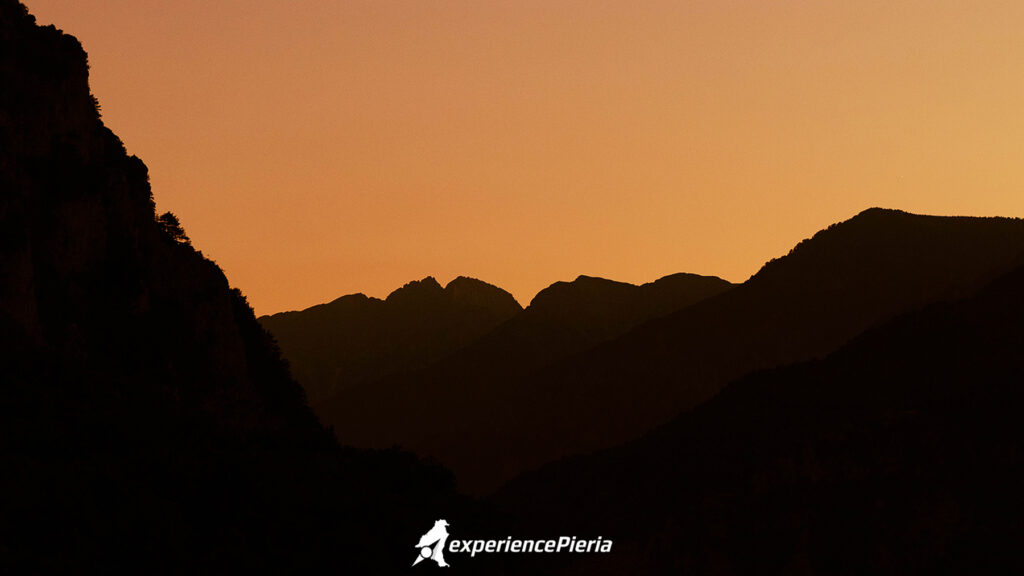
MOUNT OLYMPUS · PIERIA, GREECE
Mount Olympus, Greece | UNESCO World Heritage, Nature & Hiking Guide
Nature · Mythology · Hiking · UNESCO World Heritage
Explore Greece’s highest mountain through its forests, gorges, trails, mythology, biodiversity and remarkable natural landscape.

Photo © Yorgos Gizelis / Experience Pieria
Mount Olympus is more than the highest mountain in Greece.
It is a landscape where mythology, nature, mountains and human history have been connected for thousands of years.
From the forests and streams around Litochoro to the high alpine landscape of Mytikas and the deep Enipeas Gorge, Olympus changes dramatically as you gain altitude.
It is a mountain to explore slowly — and with respect.
In 2026, the wider area of Mount Olympus was inscribed on the UNESCO World Heritage List as a mixed cultural and natural heritage property, recognizing both its enduring cultural significance and its exceptional natural value.
Mount Olympus at a Glance
- Location: Pieria and Larissa, Greece
- Highest peak: Mytikas, 2,918 m
- Main gateway from Pieria: Litochoro
- Landscape: Forests, gorges, waterfalls, alpine terrain and mountain peaks
- UNESCO: The wider area of Mount Olympus, inscribed in 2026
- Known for: Greek mythology, biodiversity, hiking and the relationship between mountain and sea
Mount Olympus Is Now a UNESCO World Heritage Site
The UNESCO property is officially titled “The wider area of Mount Olympus”. It extends across the regional units of Pieria and Larissa and includes the wider mountain landscape together with the archaeological site of Dion.
The World Heritage Committee inscribed the property on the UNESCO World Heritage List in 2026 under criteria (vi) and (x).
Criterion (vi) recognizes the mountain’s enduring cultural and symbolic significance in ancient Greek mythology, while criterion (x) recognizes its exceptional biodiversity and concentration of endemic species.
This distinction is important because Olympus is not being recognized only for its scenery. Its significance comes from the combination of culture, mythology, archaeology and exceptional natural heritage.
From Forest to Alpine Stone
One of the most fascinating things about Olympus is how quickly the landscape changes.
Lower slopes are covered by forests, streams and deep gorges, while higher elevations gradually become more open and alpine.
The mountain’s proximity to the Aegean Sea and its dramatic elevation change create a remarkable variety of landscapes within a relatively compact area.
Litochoro — The Gateway to Mount Olympus
For many visitors, the journey to Olympus begins in Litochoro.
Located at the foot of the mountain, the town is a natural starting point for exploring the lower trails, Enipeas Gorge and routes towards the higher mountain.
Litochoro is also a destination in its own right, with traditional streets, places to eat and a close connection with the mountain that rises immediately above it.
Prionia & Enipeas Gorge
The Enipeas Gorge is one of the most accessible ways to experience the natural character of Olympus.
The route follows the water through a forested landscape, crossing wooden bridges and passing waterfalls and natural pools.
For visitors who prefer to drive closer to the mountain, Prionia is the highest point accessible by road and an important starting point for routes towards the mountain refuges and higher peaks.

Photo © Yorgos Gizelis / Experience Pieria
Waterfalls, Forests & Mountain Water
Water is one of the defining elements of the Olympus landscape.
The Enipeas Gorge and other mountain routes reveal streams, waterfalls and natural pools hidden among the forest.

Zeus’ Bath in the Enipeas Gorge.
Photo © Yorgos Gizelis / Experience Pieria

Orlias and the surrounding autumn forest.
Photo © Yorgos Gizelis / Experience Pieria
For another forest experience in the wider Pieria mountains, discover
Sotiri Rema Waterfall
near Elatochori.
Hiking on Mount Olympus
Olympus offers routes of very different difficulty levels.
Some visitors come for a short forest walk, while others spend several days moving towards the high mountain and its peaks.
If you are looking for an accessible introduction to the mountain, the routes around Litochoro and Enipeas Gorge are a natural starting point. More demanding routes require appropriate equipment, preparation and experience.
For practical information about day hikes:
Mount Olympus Day Hikes | Enipeas Gorge, Prionia & Practical Hiking Guide
.

The E4 path and the mountain landscape above Litochoro.
Photo © Yorgos Gizelis / Experience Pieria
Olympus Through the Seasons
Olympus does not look the same throughout the year.
Spring brings fresh vegetation and flowing mountain water. Summer offers different conditions in the lower mountain, while autumn transforms the forests with colour and often creates clearer contrasts between the mountain and the sea.
Winter is a completely different environment, especially at higher elevations, and should not be approached like a summer hiking destination.

Autumn colours in the forests of Olympus.
Photo © Yorgos Gizelis / Experience Pieria
Mountain Refuges & Trail Signs
For longer routes, mountain refuges become important waypoints. They provide basic mountain accommodation and support for hikers continuing towards the higher parts of Olympus.
Always check current conditions, refuge availability and trail information before setting out. Mountain weather can change quickly, and a route that looks straightforward on a map can be very different on the ground.

Krevatia Refuge and the long view across Pieria.
Photo © Yorgos Gizelis / Experience Pieria

Trail signs are essential for staying oriented on the mountain.
Photo © Yorgos Gizelis / Experience Pieria
The Mountain of the Gods
For ancient Greeks, Olympus was not simply a mountain. It was imagined as the home of the Twelve Olympian Gods, with Zeus as their ruler.
The myths and traditions associated with Olympus were recorded in ancient Greek literature, including the works of Homer and Hesiod, and later became a lasting source of inspiration for literature, art, philosophy and popular culture around the world.
The relationship between landscape and mythology can still be felt today — particularly when looking from the mountain towards the Aegean or standing beneath the high peaks.

The
Sacred Cave of Saint Dionysios
is another cultural and spiritual waypoint associated with the mountain.
Photo © Yorgos Gizelis / Experience Pieria
Where Mount Olympus Meets the Aegean
One of the distinctive experiences of Olympus is the relationship between mountain and sea.
From many points on the mountain, the Aegean can be seen far below, while from the Pieria coast the peaks rise dramatically above the landscape.

The Aegean seen from Mount Olympus.
Photo © Yorgos Gizelis / Experience Pieria
Practical Tips for Visiting Olympus
- Check the weather: Conditions on the mountain can differ significantly from those at the coast.
- Choose a route that matches your experience: Lower mountain walks and high-altitude routes are very different experiences.
- Wear appropriate footwear: Even shorter mountain walks can include uneven or wet terrain.
- Carry enough water and basic essentials: Do not assume that every route will have easy access to supplies.
- Stay on marked paths: Respect the mountain and follow local regulations and trail signage.
- Leave no trace: Take your waste with you and avoid disturbing wildlife, vegetation and natural features.
- For higher routes: Check current mountain conditions and seek appropriate local guidance when necessary.
A Landscape Worth Protecting
The UNESCO recognition also underlines the extraordinary biological diversity of Mount Olympus.
According to UNESCO, the property contains 1,983 vascular plant taxa, including 27 strict local endemics found only on Mount Olympus.
The wider property also supports numerous protected species of birds, mammals, reptiles, amphibians and invertebrates.
Its steep elevation gradient, varied terrain and proximity to the Aegean contribute to the exceptional concentration of biodiversity found here.
That makes responsible travel more than a general principle. Staying on trails, respecting wildlife and leaving the landscape untouched are part of experiencing a place whose natural value has now been recognized at a global level.
Frequently Asked Questions
Is Mount Olympus worth visiting if I am not an experienced hiker?
Yes. The lower mountain around Litochoro and Enipeas Gorge offers opportunities for shorter walks and nature experiences. Higher routes require more preparation and experience.
Where should I start exploring Mount Olympus?
Litochoro is one of the main starting points for visitors approaching Olympus from Pieria. From there, you can explore lower trails, Enipeas Gorge and routes towards Prionia and the higher mountain.
What is Enipeas Gorge?
Enipeas Gorge is a forested mountain landscape near Litochoro, shaped by the Enipeas River and known for walking trails, wooden bridges, waterfalls and natural pools.
Can I see the sea from Mount Olympus?
Yes. The proximity of Mount Olympus to the Aegean creates views from the mountain towards the sea, while the peaks themselves are visible from many parts of the Pieria coastline.
Is Mount Olympus part of UNESCO World Heritage?
In 2026, UNESCO inscribed The wider area of Mount Olympus on the World Heritage List as a mixed cultural and natural property.
Continue Exploring Pieria
Mount Olympus is only one part of the wider experience of Pieria.
Around the mountain you will find traditional villages, local producers, waterfalls, vineyards, beaches, archaeological sites, religious monuments and people whose stories are closely connected with the landscape.
Explore Pieria at your own pace:
Explore Pieria
