
Fire, Cedar & Memory
The Tsagkala Carnival ritual in Skotina, Pieria — where fire, community and older layers of memory meet.
22 February 2026 · Skotina, Pieria
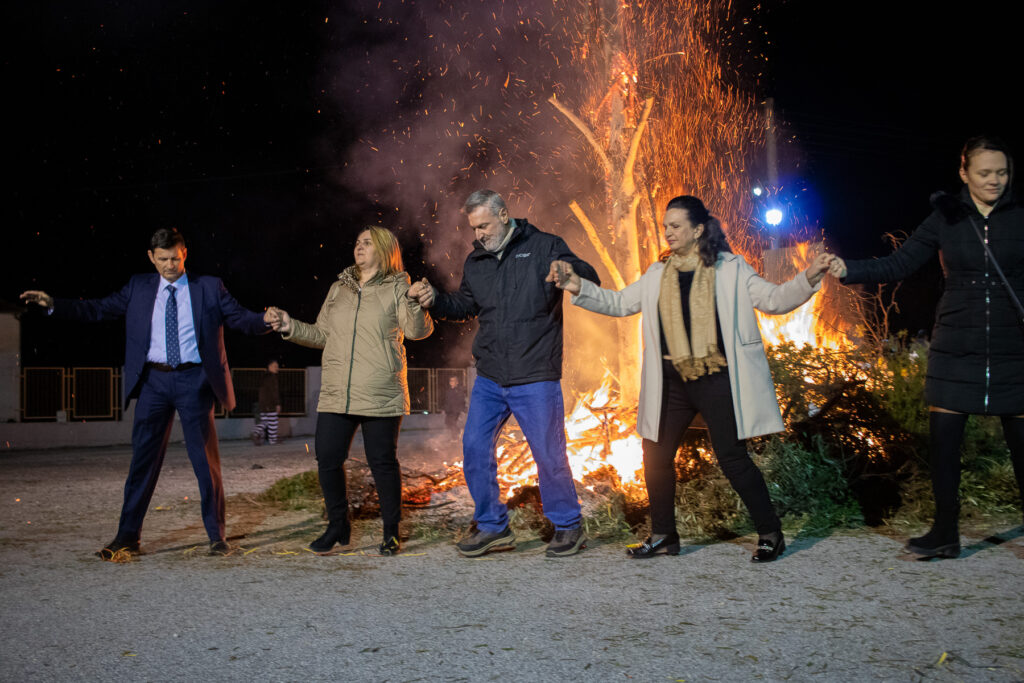
The cedar fire of Tsagkala in Skotina, Pieria. © Experience Pieria
In the village of Skotina, beneath the slopes of Mount Olympus, fire still has the power to bring people together.
Every Carnival season, a local tradition known as Tsagkala brings the community together around cedar, music, food and flame.
On 22 February 2026, I had the opportunity to document the ritual, organised by the Pneumatiki Kinisi Skotinas, at the village primary school.
For one evening, the school courtyard became something else entirely.
A place of gathering.
A place of music and dance.
And, at its centre, a fire.
Tsagkala in Skotina at a Glance
- What: a traditional Carnival fire ritual known locally as Tsagkala.
- Where: Skotina, Pieria, at the foot of Mount Olympus.
- When: during the Carnival period, traditionally around Forgiveness Sunday.
- Central element: upright cedar trunks gathered at the centre of the celebration.
- What surrounds the fire: traditional music, dancing, food, wine and community gathering.
- Cultural character: a living local tradition shaped by older ritual symbolism, Christian practice and community memory.
- Best for: travellers interested in Greek traditions, cultural heritage, photography and authentic village experiences.
What Is Tsagkala?
Tsagkala is a local Carnival tradition in Skotina centred on the lighting of a large cedar fire.
The ritual takes place in the community, rather than being presented simply as a performance for visitors.
People gather around the fire, traditional musicians play, wine and local food are shared, and dancing develops naturally around the flames.
The result is something very different from a staged festival.
The community itself is the event.
The Cedar at the Centre
At the centre of the ritual stand the cedar trunks.
They are placed upright, creating a striking vertical structure before the fire is lit.
There is something immediately symbolic about the image: wood rising from the earth towards the sky, waiting to be transformed by fire.
Cedar and other aromatic woods have a long history in Mediterranean ritual practices. In ancient Greek religious contexts, fragrant materials were burned in connection with offerings, allowing smoke and aroma to become part of the ritual experience.
That ancient background gives the cedar an interesting symbolic dimension, but the modern Tsagkala should not be presented as a reconstruction of an ancient ceremony.
It is a living local tradition, shaped by generations of people in Skotina.
Fire, Smoke & Purification
Once the cedar is lit, the character of the gathering changes.
The wood begins to crackle. Resinous aromas fill the air. Flames climb upwards and smoke moves into the night sky.
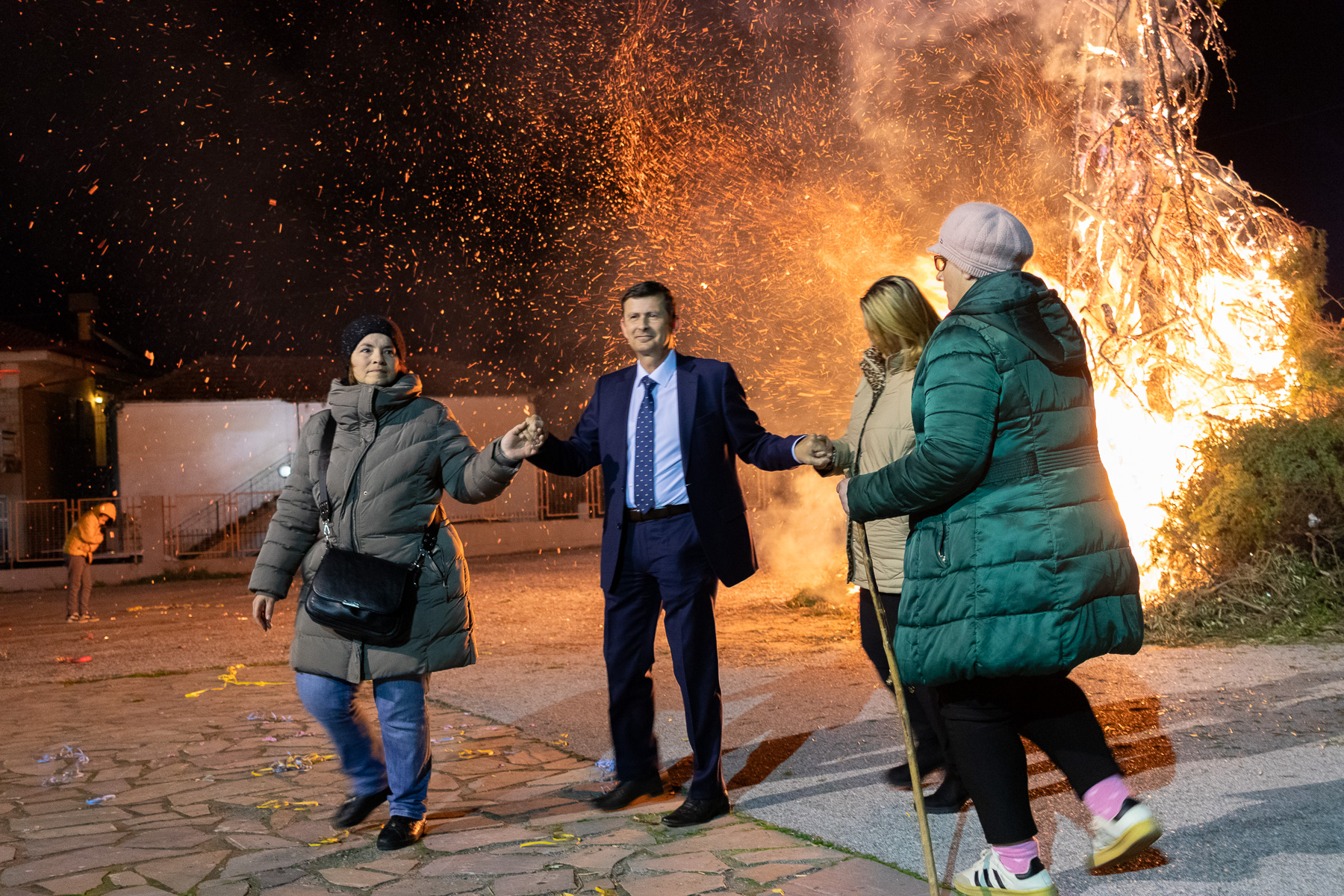
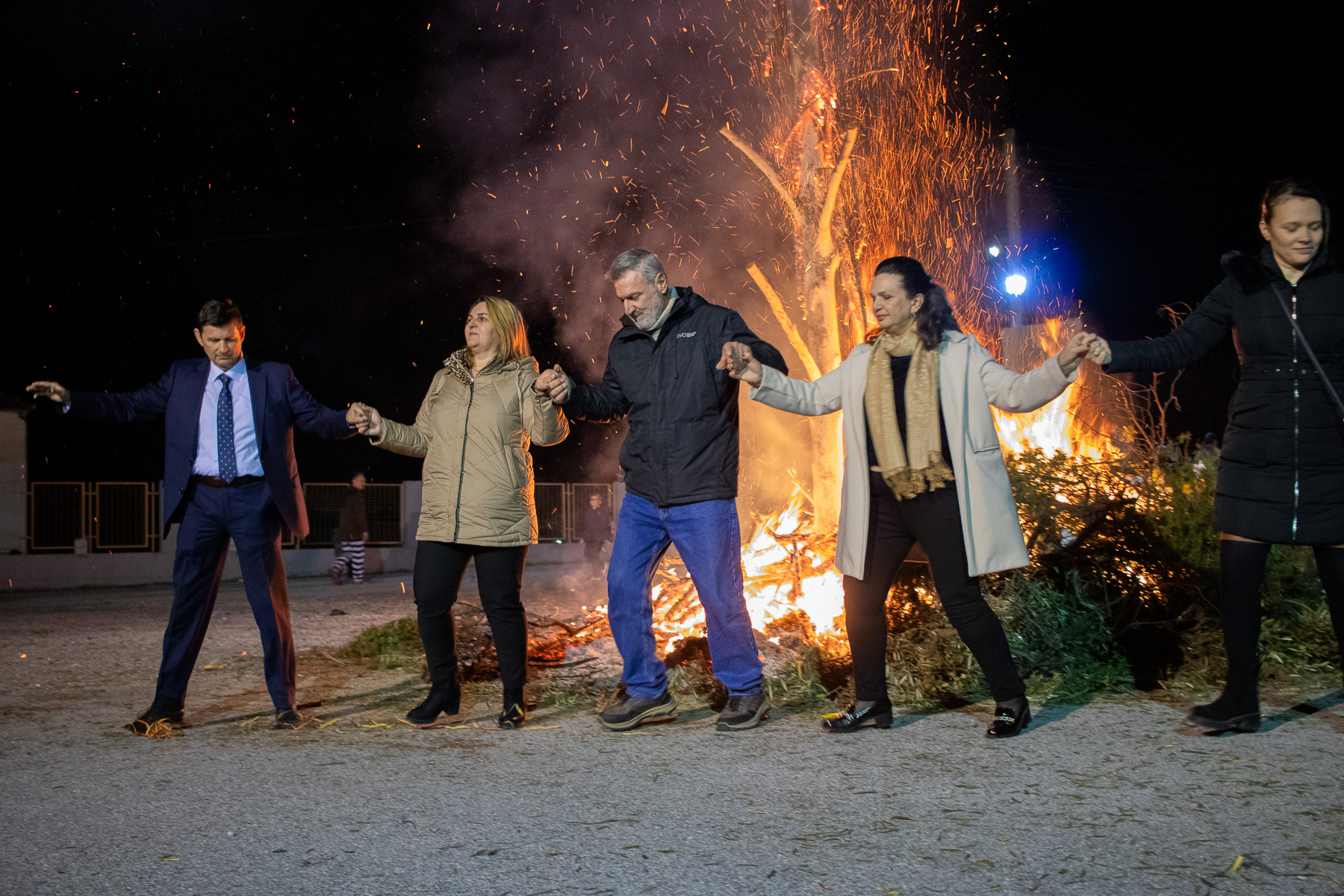
People gathering around the Tsagkala fire in Skotina. © Experience Pieria
Fire has long carried ideas of cleansing, transformation and renewal across ritual traditions.
Smoke has its own symbolism. In ancient religious practice, rising fragrance and smoke could form part of an offering, creating a symbolic connection between the human and the divine.
Seen through that lens, the smoke rising from the cedar can be understood as more than something produced by burning wood.
It rises towards the sky.
It can be read symbolically as an offering, a prayer or a gesture of purification.
That interpretation belongs to the symbolic language surrounding the ritual; it does not mean that every participant today understands the fire in precisely the same way.
Traditions evolve.
Symbols remain.
A Ritual Older Than Its Present Meaning?
The history of Greek Carnival is layered.
The Christian calendar gives Apokries its place before Great Lent, while many Carnival customs contain forms and symbols that have much older parallels.
Across Greece, scholars have compared certain Carnival traditions with elements of ancient seasonal and Dionysian ritual, particularly themes involving masks, music, communal celebration, transformation, fertility and temporary changes in everyday behaviour.
These comparisons are fascinating, but they should not be turned into a simple claim that every modern Carnival custom comes directly from Dionysus.
For Tsagkala, it is more useful to speak of ancient ritual echoes and layers of cultural memory.
The fire may carry meanings that are older than the Christian calendar, while the ritual as it exists today has been shaped by Orthodox tradition, local history and generations of people in Skotina.
In other words, the tradition does not need to be unchanged to be ancient in spirit.
From Orthodox Forgiveness Sunday to the Fire
The Tsagkala fire is traditionally connected with the period of Forgiveness Sunday, the final Sunday before Great Lent begins.
This gives the ritual a particular place within the Christian calendar.
One period is ending.
Another is beginning.
The Christian meaning of the day centres on forgiveness and preparation for Lent, while the fire adds another layer of symbolism: burning, transformation and renewal.
Over time, these different layers have existed together within the same community tradition.
A Tradition That Survived
According to Theoharis Stylos, President of the Pneumatiki Kinisi Skotinas, the Tsagkala tradition was revived in 1980 and has continued to be held every year.
Local memory also connects the custom with earlier periods of Skotina’s history, including the Ottoman era, when villagers are said to have sought permission from the authorities to hold the ceremony.
These accounts are part of the community’s oral and written memory of the tradition.
They also reveal something important about local customs: their survival is often dependent on people deciding, generation after generation, that the tradition is worth keeping.
From Neighbourhood Rivalry to Shared Fire
Older accounts of the tradition describe a time when different neighbourhood groups could have their own fires and compete over their size.
That element of friendly rivalry is familiar in many traditional celebrations.
Today, the emphasis in Skotina is on the shared experience.
The fire becomes a meeting point for the community.
People arrive.
Music begins.
Wine is poured.
And eventually, people dance.
Live Music Around the Fire
One of the details that made the evening particularly memorable was the presence of live traditional music.
The clarinet led the soundscape, while people responded with singing and dancing.
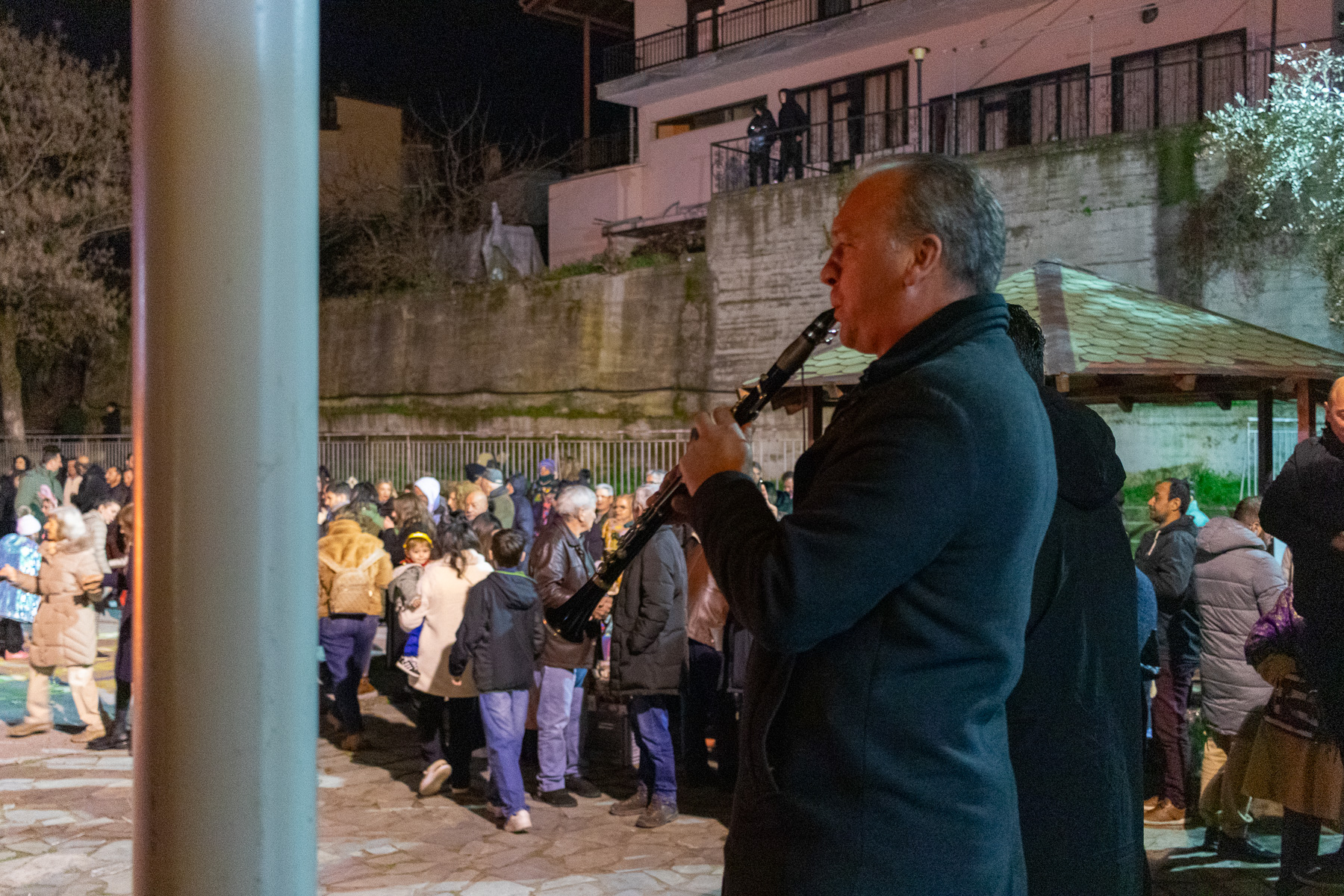
Live traditional music during the Tsagkala celebration. © Experience Pieria
There is a difference between music coming from a playlist and music being created in the moment.
A musician breathes.
The rhythm changes.
People respond.
The music becomes part of the ritual rather than simply a soundtrack to it.
Watch the 5-minute documentary recording of Tsagkala in Skotina — cedar, fire, live music and a living Carnival tradition beneath Mount Olympus.
When People Start Dancing
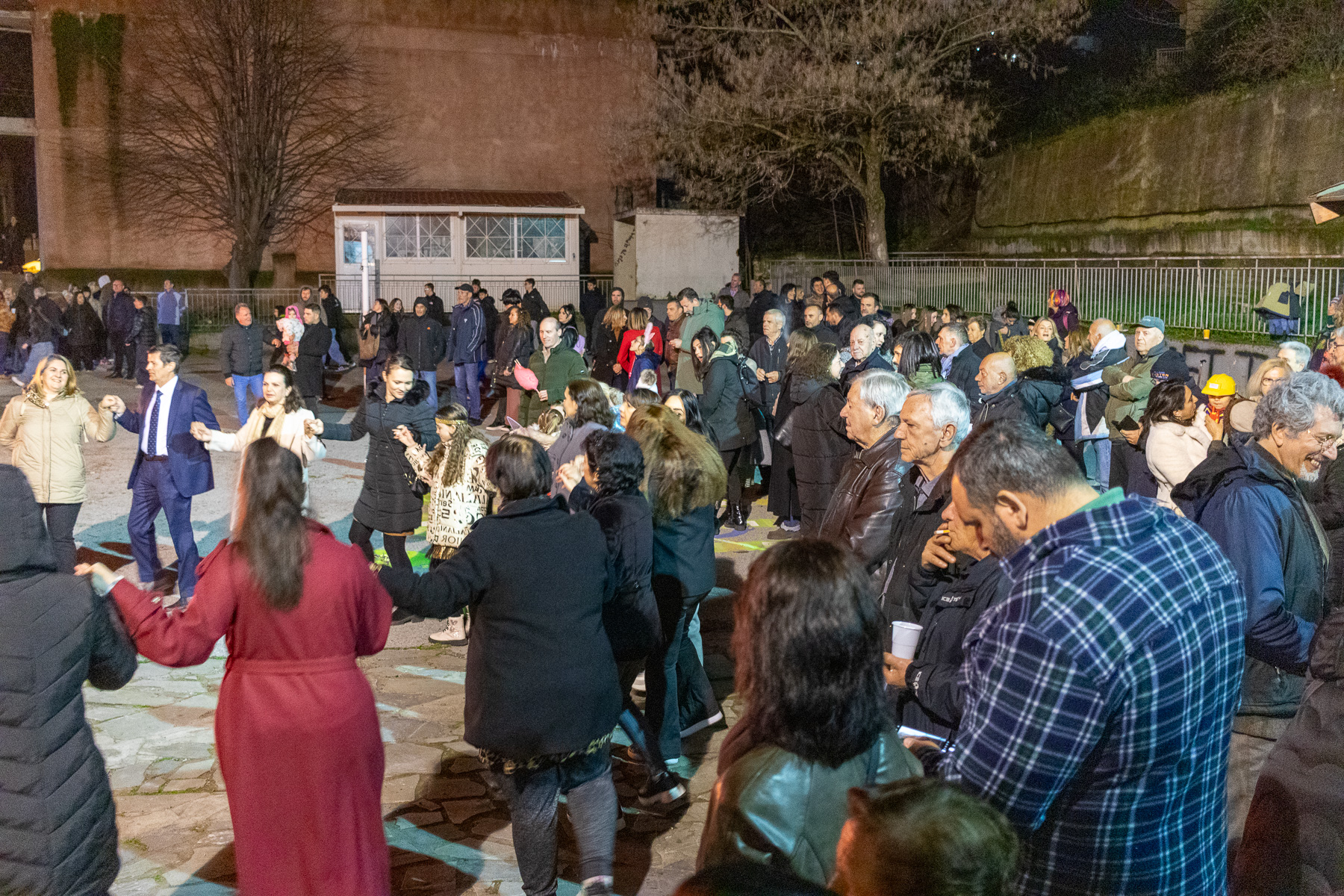
The fire draws people closer.
Eventually, circles form across the school courtyard.
Traditional dances unfold beside the flames, while different generations share the same space.
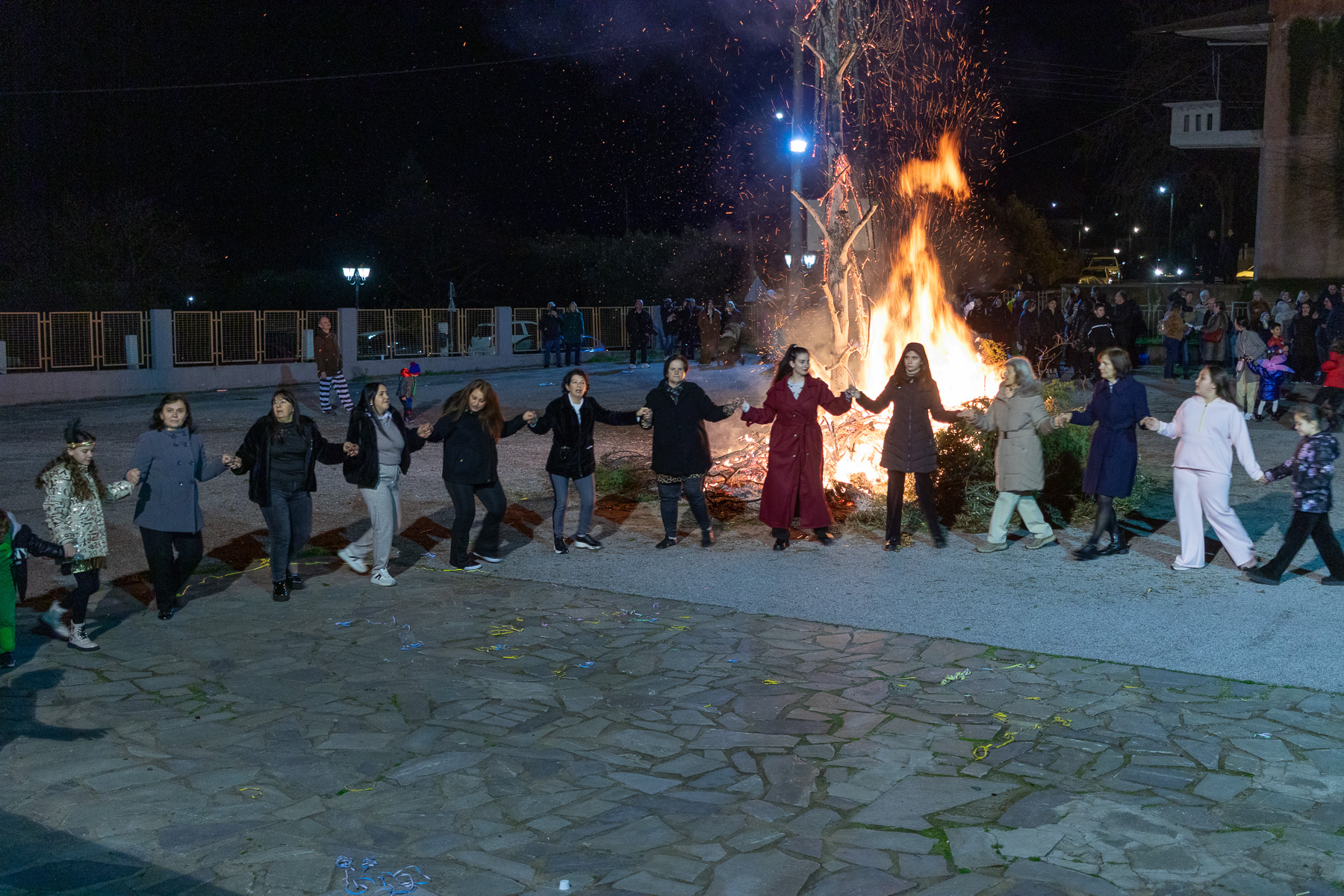
This is perhaps the simplest explanation of why the ritual has survived.
People still take part.
The Food of the Mountain
A community celebration is rarely complete without food.
During the Tsagkala gathering, visitors and locals were offered traditional Olympus pies, including cheese and spinach variations, together with sweet halva and local wine.
There was no elaborate commercial presentation.
Just food being shared.
And that is an important part of the experience: the tradition is not only about the fire. It is about hospitality, generosity and gathering around the same table.
When the Cedar Becomes Ash
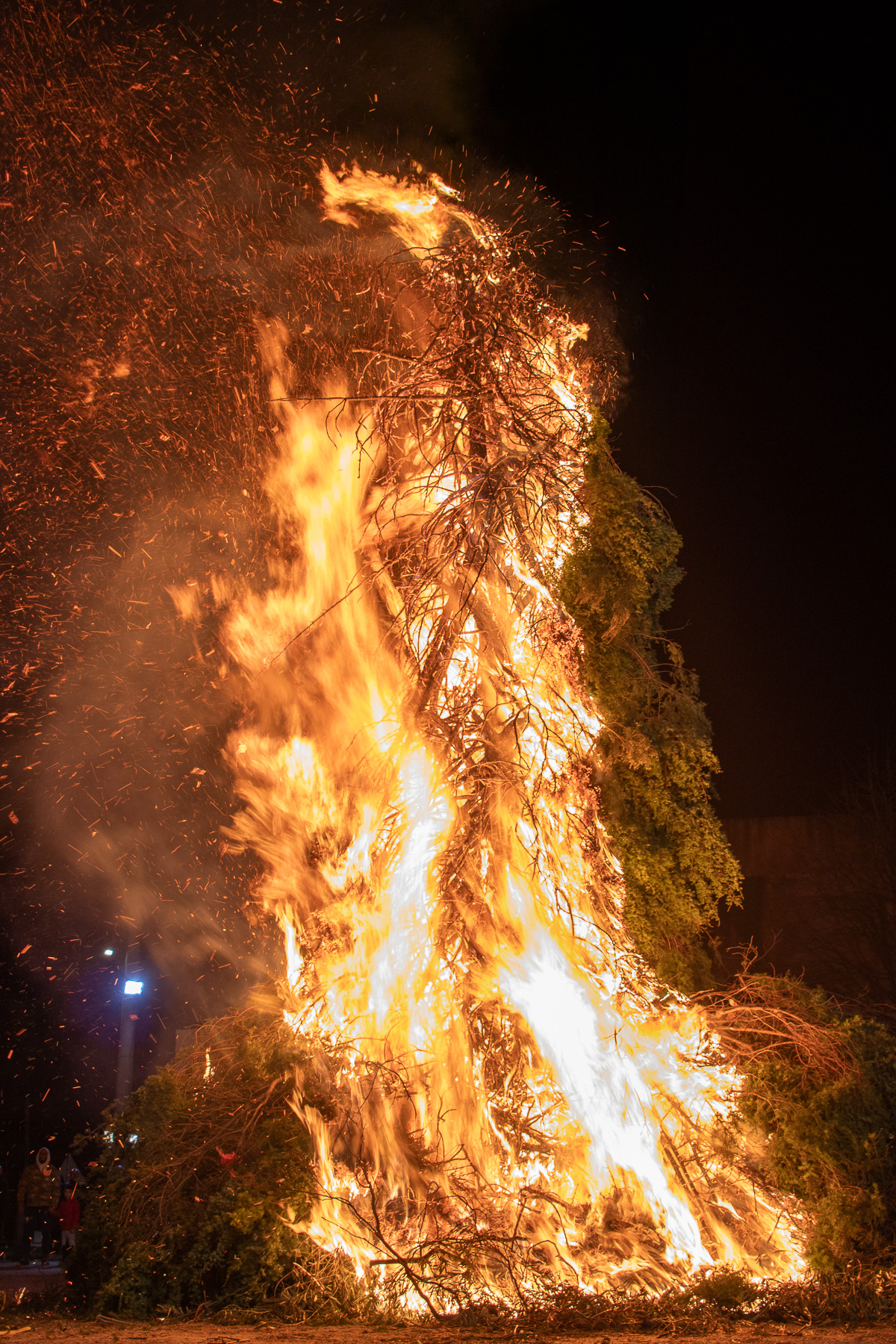
The cedar slowly gives itself to the fire. © Experience Pieria
As the night continues, the cedar trunks slowly disappear into the flames.
The structure that stood upright at the beginning becomes glowing wood, then embers, then ash.
There is something deeply human in that transformation.
Something begins.
It burns.
It changes.
And eventually, it becomes something else.
Why Tsagkala Matters
Tsagkala is not simply a Carnival attraction created for tourists.
Its value comes from the fact that it belongs to the community.
- It preserves local memory: stories and practices continue through generations.
- It brings people together: the fire creates a shared centre for the village.
- It connects different generations: older and younger residents participate together.
- It carries older symbolism: fire, smoke, transformation and renewal have deep ritual histories.
- It reflects local identity: the tradition is specific to the community of Skotina.
- It remains alive: the most important form of preservation is continued participation.
A Different Way to Experience Carnival in Pieria
Many visitors experience Greek Carnival through large parades and organised events.
Tsagkala offers something different.
Here, the experience is smaller, more local and more connected to the village itself.
You are not simply watching a show.
You are watching a community gather around something that has meaning for them.
And that is often where the most interesting travel experiences begin.
When Is Tsagkala Held?
Tsagkala takes place during the Greek Carnival period, with the main ritual traditionally connected with the final Sunday before Great Lent.
Because the date of Orthodox Easter changes each year, the Carnival calendar also changes.
If you want to experience Tsagkala in Skotina, check the local programme for the year of your visit.
Practical Tips for Visitors
- Check the date: Carnival dates change every year.
- Arrive before the fire: the gathering, music and preparation are part of the experience.
- Dress warmly: the event takes place outdoors during winter.
- Keep a safe distance: the cedar fire can generate intense heat, sparks and smoke.
- Protect your camera: smoke and ash can reach areas around the fire.
- Respect the community: this is a local tradition first and a visitor experience second.
- Ask before photographing people closely: particularly children and private family moments.
- Stay beyond the fire: listen to the music, taste the food and experience the gathering around it.
Frequently Asked Questions About Tsagkala in Skotina
What is Tsagkala?
Tsagkala is a traditional Carnival fire ritual in Skotina, Pieria, centred on the burning of cedar and accompanied by traditional music, dancing, food and community gathering.
Where is Tsagkala celebrated?
The tradition is associated with the village of Skotina in Pieria, at the foot of Mount Olympus.
When does Tsagkala take place?
It takes place during the Greek Carnival period, traditionally around the final Sunday before Great Lent. The exact date changes every year.
Why is cedar burned during Tsagkala?
Cedar is the central material of the ritual. Aromatic woods including cedar have a long history in Mediterranean and ancient Greek ritual contexts, where fragrance and smoke could form part of offerings. The modern Tsagkala tradition, however, is a living local custom rather than a reconstruction of an ancient ceremony.
Is Tsagkala a Dionysian ritual?
Some elements of Greek Carnival traditions have been compared by scholars with older Dionysian and seasonal rituals. However, it is more accurate to speak of ancient ritual echoes and cultural memory than to describe modern Tsagkala as a proven, unchanged Dionysian ceremony.
What does the smoke from the fire symbolise?
Smoke has a long ritual symbolism connected with fragrance, offering and the movement of something upwards towards the divine. In the context of Tsagkala, it can be understood symbolically as part of purification, renewal and transition.
Can visitors attend Tsagkala?
Public celebrations can be attended by visitors, but the exact programme and arrangements vary from year to year. Checking the local programme before travelling is recommended.
What else can I experience near Skotina?
Skotina is part of the wider Mount Olympus and Pieria landscape, making it possible to combine a visit with mountain villages, local food, hiking, cultural sites and other seasonal experiences.
Continue Exploring Pieria
Tsagkala is one of those traditions that is difficult to understand from a photograph alone.
You need the sound of the clarinet, the warmth of the fire, the smell of cedar, the movement of the dancers and the people standing together around the flames.
That is what makes local traditions worth experiencing: they are not simply pieces of history preserved in a museum. They are memories that continue to live because people continue to gather.
If you want to discover the wider story of Carnival in Pieria, continue with:
Apokries in Pieria, Greece | The Greek Carnival & Triodion Traditions
You can also discover the distinctive cedar-burning tradition of nearby Litochoro:
Burning Cedar Fires in Litochoro, Pieria
Explore Pieria at your own pace:
Explore Pieria
